When What Happens, Happens: Preparing for Life's Financial Curveballs

 iHeartRadio iHeartRadio
 Spotify Spotify
 Amazon Music Amazon Music
 Pandora Pandora
 Apple Podcasts Apple Podcasts
 Podchaser Podchaser
 Deezer Deezer
 Audible Audible
 Youtube Music Youtube Music
 Spreaker Spreaker
 Podcast Addict Podcast Addict
 YouTube YouTube
 Castbox Castbox
 Podverse Podverse
 Podurama Podurama
 PocketCasts PocketCasts
 Overcast Overcast
 Goodpods Goodpods
 Fountain Fountain
 Podyssey Podyssey
 Castro Castro
 Castamatic Castamatic
 RSS Feed iHeartRadio iHeartRadio Spotify Spotify Amazon Music Amazon Music Pandora Pandora Apple Podcasts Apple Podcasts Podchaser Podchaser Deezer Deezer Audible Audible Youtube Music Youtube Music Spreaker Spreaker Podcast Addict Podcast Addict YouTube YouTube Castbox Castbox Podverse Podverse Podurama Podurama PocketCasts PocketCasts Overcast Overcast Goodpods Goodpods Fountain Fountain Podyssey Podyssey Castro Castro Castamatic Castamatic
What happens when what happens, happens? Cancer, Christmas, a car repair — the surprises life throws at us all cost something. Author and entrepreneur Bart Merrell joins Bonita to explore how everyday people can build real financial security by monetizing the skills and knowledge they already have. It's a practical, mindset-first approach to being ready for anything.
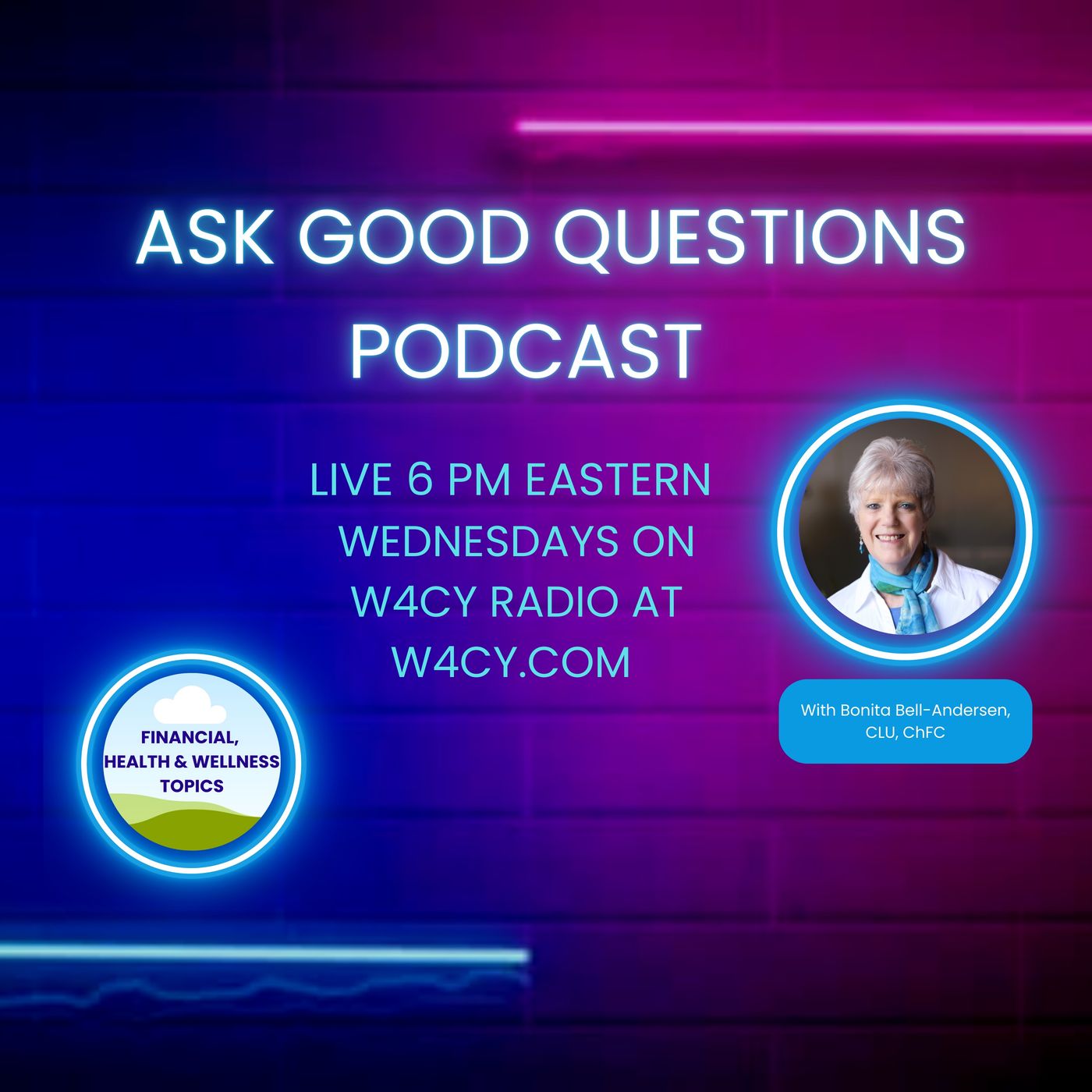
Ask Good Questions is broadcast live Wednesdays at 6PM ET on W4CY Radio (www.w4cy.com) part of Talk 4 Radio (www.talk4radio.com) on the Talk 4 Media Network (www.talk4media.com). Ask Good Questions is viewed on Talk 4 TV (www.talk4tv.com).
Ask Good Questions Podcast is also available on Talk 4 Media (www.talk4media.com), Talk 4 Podcasting (www.talk4podcasting.com), iHeartRadio, Amazon Music, Pandora, Spotify, Audible, and over 100 other podcast outlets.
Become a supporter of this podcast: https://www.spreaker.com/podcast/ask-good-questions--6441735/support.
0:00 The topics and opinions express in the following show are solely those of the hosts and their guests and not those of W FOURCY Radio. It's employees are affiliates. We make no recommendations or endorsements for radio show programs, services, or products mentioned on air or on our web. No liability explicit or implies shall be extended to W FOURCY Radio or it's employees are affiliates. Any questions or comments should be directed to those show hosts. Thank you for choosing W FOURCY Radio. Welcome to to Ask Good Questions Podcasts, broadcasting live every Wednesday, six pm Eastern Time on W four CY Radio at W fourcy dot com. This week and every week, we will reach for a higher purpose in money and life, as well as a focus on health and wellness. Now, let's join your hosts, Banita bell Anderson as together we start with Asking Good Questions.
1:00 Hey, welcome to the Ask Good Questions podcast. I am your host, Benita bell Anderson, and we have a fabulous show today with my guest Bart Merrill. Bart is someone who has had some pretty interesting experiences in life that I'm we're going to talk about a little bit. So with that, let's bring Bart onto the podcast stage. Welcome, Welcome, thank you, thanks for having me. Yeah, you bet well, I'd like to introduce you to everyone. So Bart, he kind of starts off with saying, are you prepared for what happens when what happens happens? What if it's cancer, what if it's Christmas, what if it's a car repair? You know, I had to laugh at that, because, yeah, all these things can happen, but we need to prepare for before it happens. Bart is an international entrepreneur, an author, and Monetize Your Mindset presenter. He's helped take the first commercial bungee jump to Japan, which I'm going to have him explain a little bit. He's not sure and I'm not sure about this either, because he said that he jumped off the tower with only hanging on to the bungee cord with his hands. That sounds scary. Bart. So he's been a serial entrepreneur for a very long time.
2:34 He's going to get us thinking about creating financial security by monetizing what we already know, so we have the resources to deal with what happens when it happens before because and we both know this don't we It's stuff is going to happen. So becoming a self sufficient and financially secure regardless of the economy is the global problem, he says, with a personal mindset solution. I can't wait to hear that. He's the author of the book Monetize Your Mindset, and he believes that ordinary people can succeed extraordinarily well when they pay attention to opportunities that exist all around them and act upon them. So welcome Bart.
3:23 Thank you, thanks for having me look forward to the conversation. Well, is there anything you want to add to that little intro? I didn't plan on doing this. This life happened to me in the beginning and cause me to do this. My life's goal was to become an FBI agent and chase serial killers. That is what I wanted to do. We had an FBI agent family friend that said the easiest way in is through accounting. Once you get in, you apply to the jobs that are open, and so I wouldn't have to stay in the white collar section. And so that's what I was going to do. From his advice, my dad's advice, I went into accounting. I found out two things very quickly. I didn't like it, and I wasn't very good at it, but it was a means to an end that was going to get me to where I wanted to go. I took a break right before my last semester of college, went to the farm and helped dad on the pig farm. Improved my Spanish. While I was there. I had RK surgery done on my eyes and it corrected my vision. It was really good. It was twenty twenty and one eye twenty twenty five and the other eye. I didn't have glasses again until I was like fifty two fifty three.
4:41 But I got back up to school and I started the application process to the FBI, and I found out that that automatically disqualified me from the FBI. The surgery I didn't and the surgery was still considered experimental, and so they didn't want to put money into an AG and then have him go blind and sow. Their reasoning was valid, but very disappointing. And I know, I know, I've had my own disappointments where I went really seriously ugh. And so now here we are, I am the side hustle samurai. Yeah awesome. So so you've been an entrepren I've been an entrepreneur for a very long time. I've realized long time ago that I was unemployable. I liked being my own boss. So your early ventures, what did that teach you?
5:35 What do you think that that your early ventures taught you that still shapes what you're doing today. So a lot of it was growing up with my dad. I said, my dad's a pig farmer, But he wasn't just a pig farmer. He was a businessman. He had his hands in many different things. They were just his love was agriculture, and so they were in agricultural industry specific items. But his example, he never set me down and taught me the birds and the bees of business. He showed me by example and watching him, And then anytime I tried, anytime I wanted to do something, he was always there to encourage me and help me through it.
6:16 Whether it was fundraising for the FFA and setting a goal of getting X amounts so I could get this prize or that prize, or whether it was my first venture. I bought my first stereo at age eleven, Well did I know? I just purchased a liability because every time I went to town I would have to go buy the new tunes, and that was an expensive venture for a little sef eleven year old kid. Yeah, because back then, remember we couldn't we didn't have what we have now. We had to buy the crap on the album with the two songs you wanted. Sure, we couldn't just buy one song. And so when I turned fifteen, I started my first my first business. I was a mobile disco business called Illusion. I don't know why I picked Illusion, but I guess I was an illusion. But even then, in my small town in southern New Mexico, nobody was hiring fifteen year old DJs. No, and so I had to create my own opportunity. I rented the community center. Yes, I rented the community center. Hired and off duty comp for security. Mom and dad took money at the door.
7:38 I spun records. Everybody had a good time. I was making seven eight hundred dollars a night on something I'd love to do, and it gave the community something to do after a football game, after a basketball game on the weekends, or if there. Was a serious money back in the day. For a fifteen year old kid, that wasn't bad. Yeah, well, let's jump to Japan. Let's go all the way over to Japan. And how in the world did you end up taking the first bungee jump to Japan. So I spent years there on a two years there on a on a church mission, so I knew the language when I when I finished graduating in accounting in a degree I wasn't good at. And so you came from.
8:30 Your mission, come home from your mission, start school, get your accounting. Degree, and I did. And then but then I'm devastated because I'm not going where I wanted to go. And a buddy of mine that worked for the bungee jump company jokingly asked me, well, would you like to go back to Japan? And I thought for a second, and I'm just like, I think I do, Yeah, I want to go back to Japan. And they needed someone to be the in between between them American company in the Japanese company, and I contracted with the Japanese company, and so that's how it started.
9:12 Well, didn't teach you anything about calculated risk. So the story about me jumping off just hanging on with my hands because I so. On our busiest day in Japan, I think we did seven hundred and eighty three people were pushed, i mean assisted, off the top of the tower that day, but sometimes in the in the middle of the week, when nobody was there, I was stuck alone at the top of this tower with just me and my brilliant mind. At the bottom of our tower, we had a stun personair bag, and in theory, one could jump from eight stories up without a bungee cord at all, hit the mat and be okay.
10:07 Oh my gosh. My brilliant mind started to talk to me and say, hey, you think you could do that? And I walked over to the edge of the bungee tower and I looked down and I said, no, I'm not that crazy. How much? Now? How much did it cost to do that? Do you remember what the admission price was for one person? So to get in the park itself was roughly fifteen dollars at the time, And did you and one jump on the bungee jump was of fifteen dollars? Okay, let's still do it for free. Yeah, seven or eight hundred people, that's that was some serious bucks.
10:49 Okay. So you're up there and you're thinking, all right, am I going to do this? So my brilliant mind continues to talk to me and says, Okay, you know, you could jump with a bungee cord attached. You wait for the bouncing to stop, and then you just unhook yourself and you would be falling from six stories instead of eighth. And so in my head that that was better. I could do that, and I tried that. I jumped with the bungee cord attached, but there was just too much pressure and I couldn't get it unhooked, and so they let me down. I went back up to the top. I'm still thinking about how can I do this? And my brilliant mind says, you know, when you connect the bungee cord to your customer, you have this one about a foot long, one inch thick or wide nylon strap with a carabiner at one end. You could wrap it around, hook it to yourself, and you make a loop. You put two of those on the end of the bungee cord, and what do you have.
11:58 You have handle. I could jump just hanging on to those handles, wait for the bouncing to stop, and then when it stops, all I gotta do is let go. Now that's easy. I could do that. I grabbed my handles. I went to the edge and I looked down and I said three to two one bungee and I jumped, and obviously I'm alive. Things are okay. It was fine, except for your brilliant mind. Sometimes it doesn't think things completely all the way through. I'm hanging at the end of a large rubber band. What's gonna happen? When I let go that bungee cord shot to the top of the tower with this loud bang. I hit the mat with a loud slap. It echoed throughout the park, and everybody came running to see who just died? And I'm crawling out of the mat. Ooh, nothing to see here.
13:04 I'm okay, I'm okay. All good now for your listeners and for you as well. You're probably thinking that's just stupid crazy, and and you're right. I probably wouldn't do it a second time. But if you're going to be in business, if you're going to be an entrepreneur, you have to be able to venture out, and you've got to be a little bit of brilliance and a little bit of crazy, and you got to do things even though you don't know the outcome. Right now, this isn't stupid crazy Because I had jumped a thousand times. I knew the pressure I was going to receive, and I was ninety nine percent sure I could let I could hang on. Yeah, I wasn't gonna fall, you know, my I guess my only worry is whenever you bounce back up, your body goes into that weightlessness. And I was like, oh, I hope I don't freak out and let go. But I was pretty sure that I could do it. And so it was an educated risk, not a stupid risk, because I knew the pressures I was going to feel. Yeah, And when you're in business, you have to you have to do things with an educated risk.
14:22 Well, okay, so let's talk about that tagline, what happens When what happens happens? What's this story behind that? Well, life happens. And I've had several times in my life where unexpected things happen. And one I haven't mentioned very often, but in right after nine to eleven, I lost several hundred thousand dollars in business ventures because of nine to eleven and I was this close to bankruptcy.
15:04 How did I save myself? Well, I went out and I purchased a forty thousand dollars pickup, brand new off the lot Ford one ton diesel pickup. Once again, you think, Okay, that's kind of crazy, that's kind of stupid, Risk. But I was going to pull camping trailers nationwide. I was already in the camping trailer industry shipping camping trailers to Japan. And this was I knew that this availability was out there. You have to pull the trailers from the manufacture to the dealers, and the manufacturers a lot of them are located in Elkhart, Indiana, or right around that area there in Elkhart, Indiana. I couldn't get the contract to pull the trailers until I had a truck. So I had to buy the truck without a contract, drive to Indiana, get the contract, and but and I would be on the hook for the forty thousand dollars.
16:12 Right. Once again, an educated risk, I knew I could probably get the contract. I went out there, I got the contract. I was pulling trailers nationwide. But what else did that do for me? I am in the industry of shipping trailers to Japan. It put me smack dab in the middle of all these factories to where I could meet the people that I needed to meet for my future deals. If someone from Japan asked me for this, and so it put me in there and made connections. Yeah, the connections you made were priceless. You can't put monetary value on the connections you make in life. You just can't.
16:56 And it saved me from bankruptcy because I was this close because of the lost money. But what it also did is it, like you said, the connections. It helped me when I needed different things, even though I hated it because I was gone from home twenty days out of the month. Wow. And I did that for about three and a half years. Yeah. That first truck that I bought, so I put in three years. I put three hundred thousand miles on that truck and I sold it to Japan for more than I paid for it. Wow. After the three hundred thousand miles, I bought me a new truck and I put almost one hundred thousand miles on it before I decided, you know, I don't need to do this. Yeah, there's other things I can do to make better money and sleep in my bed at night and be home with my family. Well, I sold but once again, I sold that truck to Japan for more than I owe on it.
18:05 Wow, well, you I mean you talk about cancer as well as Christmas is kind of like the those ends of those spectrums. Why do you think it's important to prepare for both the good things and the bad things that can happen in life? So for me, the next thing that happened was my wife. She called me from Japan once and she calmly informed me that the initial test indicated cancer. Now, who hasn't been touched by cancer in one way or another? I think we all have. We all have. My brother died of cancer at age fifty three. I have two sisters that died of cancer at age sixty two.
18:46 Oh wow. And so what would be running through your mind? Oh yeah, obviously the first one question. The first thing is, well I could I could lose my wife right sadly. The second thing was, we can't afford this. I can't afford to drop everything and be by her side as she's going through whatever it is she's going to go through. And so that's when I really started thinking about you know, things happen, and you got to prepare and you got to be able to take care of yourself and take care of your family because these things, whatever they may be, are going to continue to happen.
19:28 So I know someone's going to be wondering, did your wife make it through the cancer treatment? After eight sleepless nights, the biopsy came back negative for cancer. Ah, so we were lucky and we got a wake up call. Yeah, but you not everybody's going to get that wake up call. So we need to wake up before what happens happens and create that financial security by monetizing the things that you already know and do. Why do you think people wait? I mean a lot of people wait until a crisis hits. Why what do you think that is? So? I call it the caveman theory of motivation. Back in the caveman days, we didn't they didn't have a refrigerator.
20:19 So Og would go out and he would kill a mammoth and eat on it until it was either gone or rotten. Because he didn't have a place to put it he could store it and keep it. He didn't go He didn't go kill two, three or four to try and keep up with Grog across the street because Grog had two. Yeah, we just lived until we needed it. And then missus Ogg she comes out and she says, Grog, you need to get out there and go get another We're about out of food. You got to go get something. You'd got to do something. His back was put against the wall. And so we have this in our genes, in our in our humanity, where sometimes we wait until our back is against the wall before we act or anything.
21:05 And how many stories are out there of people who their back got put against the wall and now all of a sudden they're millionaires. Oh yeah, there's a lot of stories. There's there's a conference I was at once and there was I don't even remember, it's been so long ago, but there was four millionaires up on the stage. They all had ridiculous stories of woe before they made it big with whatever their company. Was exactly, So why do we have to why do we have to wait for that back against the wall?
21:45 What if we could do that before it happens. Yeah, And just a lot of these people these after their backs against the wall, they start looking around, Oh what can I do? What can I do? And they start to pay attention to the opportunities that are around them, and they make it happen so what do you do that before that? What do you think it looks like on a day to day basis to actually be prepared then for both the good and the bad. So what I have done is anything that crosses my path, good, bad or ugly, I naturally always ask how can I monetize it? Okay, I don't monetize everything, but I asked the question. Yeah, so you know, I'm a blownee amputee.
22:33 And I found out in twenty twenty three that this was going to happen about October. And when I found out it was going to happen, after the shock and awe was over, of course, my crazy mind says, Okay, I don't like this, but it's going to happen. There's nothing I can do about it, right, how can I monetize it? Six months postop, I'm in an appointment with my prostatist, and I said, Scott, you know I interviewed three other prostatutes before I decided on you. One of them had a guy, a guy that had had his leg cut off that I could ask questions, how about is this going to hurt? What about fandom pain? What about you know X y Z? What about my bathroom?
23:19 What do I need to change in my bathroom? Yeah, Scott, you don't have a guy. I'm your guy. Yeah, And so that's how it started to start our conversation. And I've been doing that for him for you know, almost two years now. See, you're perfect for that. That was the perfect way to turn that around. I gave it some purpose. And if I didn't think about it before when the opportunity presented itself, Scott didn't ask me. I told Scott. And so if you don't think about it before the opportunity comes, you're not going to be prepared for the opportunity.
24:04 Well, it's always I mean, you know, my name for this podcast has worked out so well so many times about asking good questions. I mean you basically were in that space where you were asking yourself some good questions. Yes, and I do it. I do it all the time. Naturally. It's the way I grew up. It's the way I watched my dad do it. And if if you didn't grow up with my dad or someone like my dad, you don't think like I do. And that's why I wrote the book Monetize your Mindset. So what does that mean? Tell me? Unpack that A little bit for me. What does monetize your mindset mean?
24:48 It's simple. Anything that crosses your path, good, bad, or ugly, ask how can I monetize it? And so in the book I talk about three questions or three things. What do you like to do? Make a list? What do you need to do? Make a list? What are you already doing? Make a list? How can you monetize one, two, three of those things to make a difference in your financial situation? Awesome? Well you really do. I know that you believe that ordinary people can do extraordinary things and have extraordinary success.
25:37 So what do you think separate somebody who can spot an opportunity versus somebody who just goes ugh and just lets it go. By taking action. Have another speaker friend of mine that he says, opportunities don't go away, they go to someone else, somewhere else. And so if you don't take I and I sometimes I look back on my life and I say, oh, I was lucky, or I have people tell me I was lucky, and I go, really, I'm missing a leg. I lost several hundred thousand dollars, I didn't get my dream job. How am I lucky? But if you if you look at what Cinca says. Cinica says, luck is when opportunity and preparedness meet. Right, I take it one step further, and you have to take action, because if opportunity and preparedness meet and you don't take action, nothing happens.
26:33 Right. You know who actually the person that that whenever I see this, I'm thinking about this concept, and that's Elon Musk and SpaceX and whenever. Actually the other the different that the two or three different companies out there building rockets and when one explodes, they're not like, oh, whoas me? They're like, oh, here's what didn't work, right, let's go. And they're perfecting something extraordinary, right, Yes, and they're taking those they're taking massive, calculated risks. But in the end they just keep on going. And that's what I mean. I basically see that in you. That's what you're doing.
27:24 Yes, and anybody can do it. It's not specific to me, right. They just need to ask the questions and pay attention as they move forward. Once you get in the habit of asking those questions, when something comes by, you're going to ask how can I monetize it? Yeah? And I always say that I ask how Can I monetize it? Not? Can I monetize it? No? How can? Language is important? It opens up your mind and your mind can continue to think about it. Yep. A lot of our listeners are retired or semi retired or thinking about it. How can they apply monetize your mindset thinking? At that stage of life.
28:15 They have so much wisdom, they have lived so many things, and so a lot of what they have to offer is fixing someone else's problems that they might need to go through. So I always tell people that a lot of people overlook the what do you need to do? Because a lot of times the things that you need to do are not something you really wanted to do. My leg is a good example. I help people. I get them prepared for something that I didn't want to do but I had to do. And it's a different lifestyle. I joke that my wife, before this happened to me, I would brush my teeth and hop in bed, and my wife's putting all the creams on her face and cleaning her face and doing all her makeup stuff. I'm like, hun, when you're going to shut off the light, well, now guess what. We both have a nightly retreat routine that invite in that involves washing skin and putting creams on skin and taking care of of your skin. Mine's just my leg, hers is her face, right, And so I teach people how to do that because if you don't take care of your leg, you could get an infection.
29:33 And now you're now you're get from below the knee to an above the knee, or from an above the knee to a hips art disart disarticulation, and so you have to take care of your your body and make That's what I do. That's what I help people do, and it's something that I needed to do, not that I wanted to do. And so don't overlook the things that you overcame that you can help other people do. I have a friend, her name's Nina Lee. She was my grief counselor that helped me say goodbye to my foot. And it's funny, but my prostatus told me, before you go get your amputation, get a grief counselor and have them help you say goodbye to your foot. Nina is a grief counselor not because she wanted to be. She's a grief counselor because she lost her son when he was a teenager. So she helps people that are going through similar situations and gets compensated for it. So a lot of the things that we didn't want to go through.
30:44 And for someone who is in their retired years, they have a lot of wisdom. They just need to figure out how to tweak it just a little bit to turn it into an income stream. Right. Well, another thing you say is you call financial in security a global problem with a personal mindset solution. Can you unpack that? So we have We've been taught all over the world that go to school, get a job, retire with your with your pension or whatever, your social security, whatever it is.
31:29 We've been taught that. And a single job just doesn't get it done anymore, no, you know you And to get a part time job, you're you're once again you're trading time for money right at what? Who knows what hourly rate? Is that worth it to you? Or can you make more doing something else? I have made a lot of money doing other things, just off of things that I like to do, need to do, or was already doing. Right, And we don't think like that. In fact, we have a phrase out there, jack of all trades, master of none. We use that phrase the opposite of what it's meant to be. Yeah, the full quotation is jack of all trades, master of none, though oftentimes better than the master of one. Ooh, it's the complete opposite.
32:31 And so anybody that uses that phrase halfway, they're lying to everybody. Yeah, but that's that's the mindset we've created. You got to focus on one thing. No, you don't want to keep all your eggs in one basket, because what happens if there's a layoff? What happens if you get hurt? What happens if AI comes and takes your job and your whole industry is gone. Yeah, it's not the safe play. It's not security anymore. Security is having multiple streams. Yes, I learned that a long time ago in my entrepreneurial journey. So what's the first step somebody should take if they're feeling I'm really a prepared. This is motivating me to start getting prepared. What would be the first step that they should take.
33:28 That's a tricky question because we're not in their mindset, So it depends on their mindset. But you've heard the when's the best time to plant a tree? Twenty years ago. But if you didn't do it twenty years ago, that's planet now. Yeah. So put good stuff in your head, like listening to this podcast. Put yourself around people who think like the way you think, the way that you want to, whether it's through YouTube or whether it's through networking events. Start building your mindset so that you have that entrepreneurial mindset, and then how do you find your opportunities that are all around you. Start at with those three questions, what do you like to do? Make a list?
34:20 What do you need to do? Make a list? What are you already doing? Make a list? And then you're going to go with each of those and you're going to ask a couple of questions. Can I turn it into a stream of income? That's one? And then do I like it? How much do I like it? Is it something I want to do? So you're going to have to go out and do your research. You're going to have to go out and ask the questions, is this viable? Is this something that can be done? And then do I want it? Everybody says, Oh, I wish I was Basils, or I wish I was Musk, or I wish I was Mark Cuban, whatever billionaire you you want to pick, But are you willing to trade this to get this? Mark Cuban slept on everybody's couches for a long time. Yeah, Elon Musk still lives in the office.
35:14 Yeah. Is that the lifestyle you want? Quick example, in my trips to and from Japan, there is a Japanese restaurant that I love. It's called Koko Ichibon Curry. It's a curry, a Japanese curry restaurant, and it is It is amazing. And if you go to one on a Friday or Saturday night, that's buy an army base in Japan. You think you're in America because that's where all the GI's are hanging out. Sure, and so in my head, oh, I love curry. This would be great in America. I need to take it to America. I had a financer in Japan, a friend that would lend me the money at a ridiculous rate. It was like, if we may, if you make money, we share it. If you don't, don't worry about it. I had to ask some of my other Japanese friends, did he really mean? Does that really mean? What he what? I thought it means like, yeah, so I had free money to get this started. I got back to America, I started doing my research, talking to restauranteurs, and I decided, you know what, I don't want to work that hard. I love to eat the stuff.
36:28 I don't want to oversee making it in. I was like, oh, and. So I said no, I get I said no to free money. Yeah, but that was a smart thing to do. Exactly for you. And that's what people need to do when they're looking at these opportunities. I have to give up this to possibly get this. Is it what I want to do? Yeah? How long do I want to do it? If it is what I want to do? Yeah, So supposedly in the restaurant industry, after a couple of years, I could be more hands off. I just didn't want to do it for a couple of years.
37:12 Well what if someone's never really thought of themselves as entrepreneurial but they're inspired by this, where would they start? Oh, there has not been a better time in the history of the world to start business. With the invent of AI, there is so much you can do. I fired I fired my web guide. The other day. He wanted to charge me fifteen hundred dollars plus to make my website more AEO friendly, which means anytime you ask chat GPT what's the best dog trainer in the area, chat chat GPT doesn't see you like SEO does. And so I needed to make some changes to become AEO friendly.
38:00 I rebuilt my whole website for fifty dollars and maybe two days of time. Yeah, because of AI that's out there, and so it is. With AI, you can you can do it cheaper. It'll save you money, it'll save you time and increase your chances of success. It is just it's crazy. There hasn't been an easier time to start something. Well, okay, so that's going to lead me right into tell us a little bit about this blind spot assessment, right.
38:43 I think mine was very it was very instructive to look at mine, and so tell us about what you're saying that somebody can discover something about themselves in ten minutes. So what this assessment will do And I'm going to have to say ten minutes might be a little bit a little bit over zealous in my to. You need to think about it and think about these questions and give it the correct answers. And that's probably going to take you closer to thirty minutes. So sorry about the ten minutes. Okay, it's going to take you probably thirty minutes to do this. And if you are answering, like I said, giving thoughtful answers and really thinking about this, it's going to point out the good things that you already have in place that you can build upon, and it's going to give you the one or two things that you're overlooking that you may be.
39:46 In my little assessment, it was top three strengths, top three blind spots, which I think is like, that's instructive and a thirty day action plan. Wow. Yeah, And and it is your assessment is going to be different than anybody else's, right, and I and I created this with AI, and so AI looks at every answer and it pulls the good things about you and it said, oh, this is going to be good. This is what their strength, their strengths are, and then hey, maybe you need to pay attention to these things to make a difference, and this is how to do it.
40:26 And and so it just is it's just a wake up call. It's to help you think about things before you know everything. Hey, maybe I can do this because taking that that step into jumping off the bungee tower, just hanging on with your hands, that's hard. That's hard stuff. And when I'm saying that, I'm meaning taking that step into entrepreneurship. You have so many people, and a lot of times it's the people that are the closest to you. They're saying, Oh, you can't do that, right, you can't do that, and then you and then you're worried about, oh what if I can't, and then you start and so so now I'm going to lead to another thing.
41:13 And so that's why you need a mentor to surround yourself with good people that can help you and give you the ah, you can do this. I know that was hard. I know that happened, but don't let it get you down. You know, you need that mentor to help you and help you get through it. Whether it's someone you hired as a men for mentorship, or whether it's just those that are that you're watching on YouTube. I watch Gary Vaynerchuk all the time or Ed my Left. I mean, there's so many people that influence me just and they don't even know they're an influence to me. Right, But I'm putting good stuff in my head to help me prepare for when the hard times come, right, And that's why I said, when you plant a tree, if it wasn't twenty years ago, planet today, right, and make it happen. There's nothing I can say right now to get you there. You're going to continually do something every day for the next several years to help you fortify your brain. Right.
42:13 I feel like it's baby steps. Is just a little action on a consistent basis. And do you know that we're just about out of time? You know, which always I'm always like, you know, we're in the middle of this, and it's like, oh, we're out a time. So just a reminder that there will be information. There's a place where I have downloads about you know, for guests on my website, that people will be able to be able to find that assessment and take it. And so with that, if someone was going to remember just one thing from this conversation today, what would it be.
42:54 How much time do we have? Two minutes? Two minutes? Okay, real quick? Have you heard the story Acres of diamonds? Acres of diamonds? For those who haven't heard, it's about a Persian farmer who sold his farm win in search of riches. He died broke alone in a foreign land, never found them. I talk a lot about and then the owner of his farm was wandering his camel in the brook and he looked down. There was a rock. It was a diamond. Acres of diamonds were discovered in alia Fed's backyard. Yeah, we have a similar story. It's called acres of pig poop. I mentioned that my dad was a pig farmer and in his mid sixties he decided it was time to shut down the pig operation and go in search of his next big thing. Now, at any one time on our farm, we had nineteen thousand roughly pigs, two thousand sows, and we averaged asal can give birth two point five times a year, and we averaged nine point nine seven pigs per litter. And that creates a lot of pig poop. And we had these three man made ponds that we called the lagoons, that we would divert the stuff into settling ponds. This year here, this year here, just rotate and rotate. After Dad shut the pig farm down, he went in search of his next big thing. He died at AJD one never found it. Two years after he died, we sold
44:24 the farm for two hundred and thirty five thousand dollars, a fair price for the property. The new owners. About six months later, they were leveling those man made ponds that had been dry on top for years, and as the heavy grader was going across the middle of one of those ponds, it broke through the crust and sunk up to its belly in this black muck. They called in experts. The experts right there on the spot offered the new owners of our farm two thousand dollars a ton for the stuff. That's a dollar a pound for old pig poop. Yeah. The farm that we sold for two hundred and thirty five thousand dollars was now worth over a million dollars. Yeah.
45:11 So what about you, the people who are listening what's right there in front of you that you're overlooking. Don't be like Alia Fed and my dad, because your your opportunities are right there, right in your own backyard, right there within your grasp, right there under your nose. Well, with that, we have got to wrap this up today. Thank you so much for joining us today. Bart, Thank you really appreciate it. I think that this is given given people a lot to think about, they'll be able to find that assessment and think about you know. I just it's like, ask some good questions, right, yes, yeah, of yourself, ask some good questions of yourself. So with that, thank you so much Bart for joining us, and thank you so much for joining the Ask Good Questions Podcast.
46:12 We'll see you next time. Today's episode is over. But we did ask Good Questions again, didn't We don't miss out as we broadcast live every Wednesday, six pm Eastern Time on W FOURCY Radio at w fourcy dot com. Joined Benina Bellen. We're sing next week for more conversations with experts on finances, retirement, behavioral finance issues, health and wellness. And more. Until then, remember to ask good questions.


