Can I OR Can’t I? The Stories That Prove Every Limit Is Self-Imposed

 iHeartRadio iHeartRadio
 Spotify Spotify
 Amazon Music Amazon Music
 Pandora Pandora
 Apple Podcasts Apple Podcasts
 Podchaser Podchaser
 Deezer Deezer
 Audible Audible
 Youtube Music Youtube Music
 Spreaker Spreaker
 Podcast Addict Podcast Addict
 YouTube YouTube
 Castbox Castbox
 Podverse Podverse
 Podurama Podurama
 PocketCasts PocketCasts
 Overcast Overcast
 Goodpods Goodpods
 Fountain Fountain
 Podyssey Podyssey
 Castro Castro
 Castamatic Castamatic
 RSS Feed iHeartRadio iHeartRadio Spotify Spotify Amazon Music Amazon Music Pandora Pandora Apple Podcasts Apple Podcasts Podchaser Podchaser Deezer Deezer Audible Audible Youtube Music Youtube Music Spreaker Spreaker Podcast Addict Podcast Addict YouTube YouTube Castbox Castbox Podverse Podverse Podurama Podurama PocketCasts PocketCasts Overcast Overcast Goodpods Goodpods Fountain Fountain Podyssey Podyssey Castro Castro Castamatic Castamatic
What do alligator wrestling, epic fantasy novels, & financial planning have in common? Tom Cladis! Tom joins Bonita to explore how the limits we accept as "truth" are often just stories we've never questioned — & how choosing "can" over "can't" can transform life at any age. Expect bold stories, hard-earned lessons, &a fresh challenge to live more boldly. Especially as we are aging, retiring, & reconsidering what’s next, join us as we look at this through humor, adventure, & hard-won wisdom.
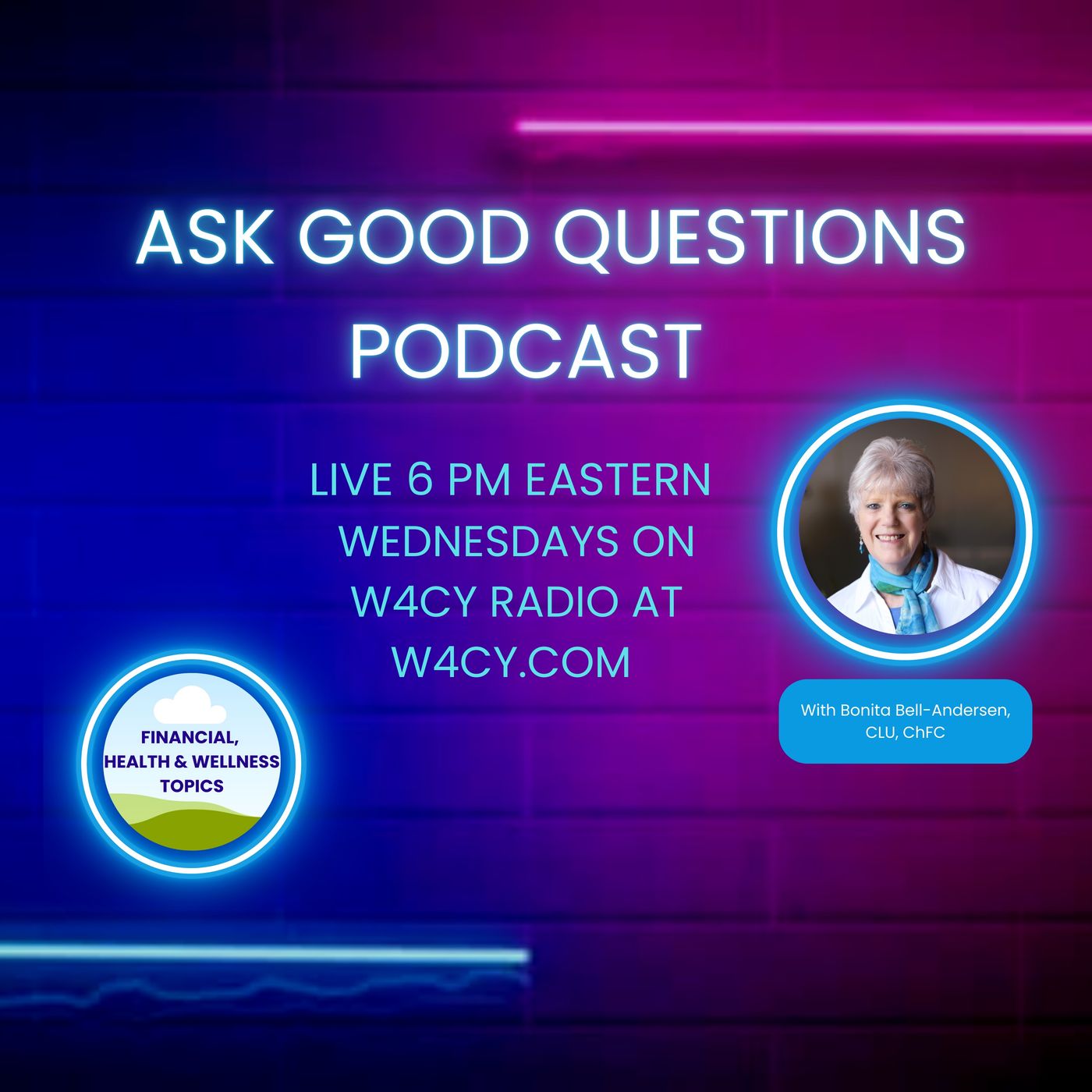
Ask Good Questions is broadcast live Wednesdays at 6PM ET on W4CY Radio (www.w4cy.com) part of Talk 4 Radio (www.talk4radio.com) on the Talk 4 Media Network (www.talk4media.com). Ask Good Questions is viewed on Talk 4 TV (www.talk4tv.com).
Ask Good Questions Podcast is also available on Talk 4 Media (www.talk4media.com), Talk 4 Podcasting (www.talk4podcasting.com), iHeartRadio, Amazon Music, Pandora, Spotify, Audible, and over 100 other podcast outlets.
Become a supporter of this podcast: https://www.spreaker.com/podcast/ask-good-questions--6441735/support.
0:02 Welcome to the Ask Good Questions podcast, broadcasting live every Wednesday, 6 p.m. Eastern Time on W4CY Radio at W4CY. com. This week and every week, we will reach for a higher purpose in money and life, as well as a focus on health and wellness. Now, let's join your host, Benita Bell Anderson, as together we start with asking good questions. Hey, welcome to the Ask Good Questions podcast. I am your host, Benita Bell Anderson, and we have a fabulous show for you today. Maybe something that you wouldn't expect.
0:46 A lot of times I'm dealing with people that are in the financial world. This guy is in the financial world, but we're not going to talk finances. We are going to have a good time talking about a lot of really interesting things. And with that, I'd like to invite Tom Kladis to the podcast stage. Welcome, Tom. Morning, Benita. Very happy to be here. Awesome. Let me tell you a little bit about this guy. He calls himself a free thinker, a wrestler, actually in alligator wrestling, a provocateur, a Christian, a thrill seeker, an adventurer, a warrior, and a certified alligator wrestler. He's also a financial planner. But we're not going to talk about finances today, are we, Tom?
1:36 No, no, that's the uninteresting part. Yeah, that's boring. So he's been called a lot of things. One of them being a blasphemer. George Bernard Shaw said all great truths start out as blasphemies. He also believes that. He wants to seek out and embrace the great truth of life and living without limits that God has provided for us. He believes minds are like parachutes. They have to be open to function properly. He's also written some books. He's published one non-fiction book called How to Lift Cars Off Your Face and Other Tips for Living Forever. And he's also gotten into novels, into fiction. And this one is called age of serpents and scorpions because his first love as it turns out is writing and he discovered that about himself so anything you want to add to that tom.
2:41 That pretty much sums me up if you can put me in a box that's uh that's it. I don't think you're one to want to be put into boxes. No no and that's that's always been my driving um my driving goal. It's a long time ago. There was this, it's called Myers Briggs. I don't know if you're familiar with it, but it's a, it's a personality profile and everyone was, they, they know you by, by certain letters. I'm a, I'm a AFG. I'm a H Q Z or something like that. And it, it always, my, my wife always wanted me to take the test. I said, no, I don't want to be defined by letters. I don't want to be put into a box. I lived, I live outside the box. There's no box that can contain me.
3:27 So that's from the very beginning. I've never wanted to be categorized as a certain way. Well, you have wrestled alligators. We don't have time today to get into alligator wrestling, but you've wrestled alligators. You've performed handstands on mountaintops. How in the worldâ and you're a financial plannerâ How in the world do all these things coalesce to come together and shape who you are now? Um, it's, it's, again, it's, it's, it's for me, uh, pursuing adventure and, um, uh, I've never said no to anything. Um, and, uh, you know, um, not wanting to be put in a box.
4:15 I don't know how many financial planners, uh, wrestle alligators, but I don't think there's too many of them, but, uh, I've always, uh, I've always, um, pursued uh adventure and um i jump out of airplanes i i bungee jump out of hot air balloons i wrestle alligators and my friends they're always pushing me is that's how wrestling alligators came up they said well why don't you wrestle alligators it's like you know, it never occurred to me that I couldn't do it. And it's just like, I just want to experience life and the freedom of living without limits. And, you know, a lot of people will think, well, wrestling alligators is too dangerous. Um, But in my mind, the danger is real, but fear is a choice. And I choose not to fear and just focus on what I want to happen. So there's nothing I feel that I can't do, and I'm always pursuing it.
5:13 Well, a long time ago, you told me a little bit about this story. You became a flight attendant, and along the way, you become a financial planner. And now you're really moving into being an author. And it seems like the throughput for all of those is wanting to experience life. Because what has pulled you? Is there something that has pulled you towards each of those different things? Thank you. There is. When I was in college, I was having lunch in the dining hall. I had only 20 minutes between classes, and a young girl sat next to me, very attractive. I thought it was going to go in a different direction than it did. But she was a philosophy student, and she was taking a survey for her class, and she was asking people, what they wanted to get out of life. And again, that's not what I was hoping the conversation would have led to.
6:13 But it occurred to me, I gave it some thought, and Bonita, I thought, you know, I don't know how it's going to happen, but I want to, in some way, impact people's lives and help them to live better lives or make their lives easier in some way. And so, again, I didn't know how that was going to happen. I met out of college. I became a flight attendant. I was flying around the world, going to different places, meeting exciting people, having great experiences. And this was before the age of the Internet, of the World Wide Web. And so I was always writing letters home. to friends and family and telling them all the things I'd been doing. And, you know, I'd have some fun with it. I'd juice them up a little bit. And people enjoyed receiving my letters, and I found I enjoyed writing them. And I won a short story writing contest. I wrote a short story called everything you always wanted to know about flying, but we're afraid to ask. And it occurred to me, this is how I can reach people. This is four years out of college. I figured it out. This is how I can impact people. So it's what I wanted to do, but it's, it's hard to segue from, from, going from a flight attendant to being, uh, an author, uh, right away and being able to support a family. Uh, I was, uh, I got married and had three young children. And so, um,
7:43 so my degree in college was, uh, business administration and, uh, I hooked up with a person who had his investment company and he hired me. And so financial planning is, that was the, uh, That helped me put a roof over my kids' heads and food on the table. But still, I neverâ and, you know, actually, I still was impacting people and helping them with their finances, financial planning. And so that was still consistent with where I saw myself going. But in the back of my head, my passion was riding, and I knew I could do much more than help people financially, help them live better. better and fuller lives and so I started writing and my writing time was from four to eight in the morning on Saturdays and Sundays because that's the only time I had the phone wasn't ringing no one was calling my name I had complete quiet where I could really dive into what I was writing and so it all kind of came together I didn't plan it that way but you know it's just that's how it happened Well, that's how those all those coalesce. Yeah.
8:56 Yeah. And then the next thing I wanted to comment on is you talk about the limits that we have in our lives or those that we self-impose them. Where did that idea of where did you first begin to believe that limits are self-imposed? Well, in the intro you mentioned I'm a Christian. I was going to church every Sunday, Sunday school, and we... We were studying the Bible verse Matthew 17, 20. And in that Bible verse, and I was a young kid at the time, you know, it was probably before I turned 10. But we're having all these discussions. And in that Bible verse, Jesus is telling us, if we have the faith of a mustard seed, nothing will be impossible for us. And that really resonated with me. It's just like, I like the idea of nothing being impossible for us.
9:56 And it was described to me as a partnership with God. And God's part of the deal was providing his access, authority over all things to us, giving us access to that. Our part was having the faith of the mustard seed, just believing that we could do this. And So the secondâ and it occurred to me that at a young age that, you know, if we stop to think that something is impossibleâ That breaks the conduit because, you know, on one side of the fence you have God through whom all things are possible, and on the other, opposite, away from God, things are not possible. And if you think for a second something's not possible, you know, it puts you on the opposite side of the fence from God.
10:49 When Peter, one of his disciples, was in a boat in the Sea of Galilee and Jesus called out to him, uh to walk on water it was a huge leap of faith because peter couldn't even swim and so he got out there and and uh he but with his heart mind and soul he believed everything was possible through through jesus and he stepped out of the boat he's walking on water and what happens bonita there's a gust of wind that comes up he has a moment of doubt he sinks in the water and uh jesus puts it, helps him back into the boat, and he says, Peter, why did you doubt me? And that's the whole thing. I think there's a real crisis of belief here where people, Christians, claim to believe in God and Jesus, but they don't believe what they say. I got into an argument with one of the archbishops of the Catholic Church over this Bible verse, and And I said, you know, I believe that if you have the faith of Jesus, Jesus wasn't a kidder. I don't think he was putting us on.
11:56 And the bishop tried to tell me, he said, well, that's not really what Jesus meant. And I said, uh-oh, uh-oh. That sounds a lot like what the serpent said to Adam and Eve in the garden that, you know, did God tell you that you'd die if you take a bite of the forbidden fruit? And he didn't really mean that. And it's just like that's where the conversation ended. The bishop didn't like being compared to the serpent in the garden. But I took these things very literally. And so that's always been my guiding force. It's just we have to overcome these things. these limits that we put in our minds that, that are self-fulfilling. They're, you know, they're all, all limits are self-imposed. We're not created to have limits.
12:39 Right. And another thing that you've said is that life is meant to be experienced, not managed. It seems like through all these experiences that has been, I mean, I think that that's been defined for you again and again and again, right? Right. You know, I've been asked to lecture in schools. And when I go into classrooms, I take with me a 10-foot-long piece of 2x4. And I put it on the floor, and I ask the students to walk across the 2x4. And they said, well, this is silly. It's easy. I said, well, just do it. And so they walk across.
13:21 They hop. Some of them walk backwards, proving to me it's the easiest thing in the world. And then I say, okay, now I'm going to, then I elevate the board between two desks, three feet high. Tom, this is easy. They still do the same thing, showing me how easy it is. And then I tell them, okay, look, in Colorado, there's a big canyon. It's called the Royal Gorge, 1,400 foot drop. And I'm going to put this board across the Royal Gorge. Now I want you to walk across it. And they say, no, we can't do it. I said, why? You just proved to me that it's the easiest. the world for you to do what's changed well we might fall and i said oh so your focus has changed on on something that's you know is the easiest thing to do onto a negative outcome and so my whole goal is to get people away from thinking about negative outcomes and limits and onto things that Yes, you can do this. And, and so that message that really resonates when I was, uh, when I was, um, The first time I went skydiving, I was a flight attendant. And I don't know if you ever saw the movie The Spy Who Loved Me.
14:33 But in that sequence, it's a James Bond movie. He's skiing down a slope in Switzerland. There's these bad guys chasing him. They're shooting at him. He skis off of a cliff. He sheds his skis. In his backpack is a parachute. He parachutes down to the ground, takes off his jumpsuit, and he's wearing a full tuxedo. He walks into the ballroom and gets the Bond girl. And I thought that was so cool. But the person who was in charge of filming that sequence was on one of my flights, owned a skydiving school in Oakland, California. And he said, Tom, come out to California and I'll teach you how to skydive for free. And I'm 22 years old. I said, oh, my God, this is so exciting. You know, I'm always pursuing, you know, pursuing that. And I had my next block of four days off. I was supposed to go home and see my parents. I called my mom.
15:22 I explained to her. You know, I'm going to go out to Oakland and learn how to skydive. And she goes, Tommy, no, you're not. And I said, Mom, yes, I am. I'm 22 years old. You can't tell me what to do anymore. And she said, Tommy, don't do it. And it's like, Mom, I'm going to do it. I'm sorry. I'll come home on the next block of days off. So we hung up. And as I'm packing my suitcase, you know, it occurred to me that every time growing up when I did something my mom told me not to do, Something went wrong, and I didn't want to be falling to earth with a parachute that didn't open, and my last thought being, I should have listened to mom. And so, Benita, I didn't go. I was so furious with her and with myself.
16:10 It's just like that doubt she put in my mind, it just blossomed, and I couldn't do something that I desperately wanted to do. I've got to interrupt you. I've got to ask this. So you've said that all limits are self-imposed, but there's a difference. There's got to be some limits that are real, right? And ones that we've just accepted without question. And so frame this with that, that there are some limits that are real. I don't believe that.
16:51 You know what I, you know, the thought that just came to my mind was that sub that imploded. Because they, remember that several months, last year sometime? So tell me why you do. That. Why I believe that there are no real limits. Well, because Jesus told us there weren't. And the example I give of, well, we had this in a previous conversation. Lance Myers, this kid in Hortonville, Wisconsin, 18 years old, working on his car at his girlfriend's house. The car fell off the jack onto his face, and there was no one around for him to help him get out from that. So he lifted the car off his face.
17:36 And when reporters find out about that, they ask him, Lance, how are you able to lift this car off your face? And he said, because I didn't want to die. So in choosing to live, he had to simultaneously subconsciously choose to remove this bear in his mind that he couldn't lift a car. And he lifted the car. You know, if we were walking down the street and we saw a car on the side parked on the side of the road, and I said, Lance, leave that car alone. lift that car. He said, I can't do that. But when he was forced to make a choice between life and death, he removed that barrier from his mind and he was able to lift the car. So that's an example. It seems like a hard limit that we shouldn't be able to lift a car. Peter walking on water, that's defying gravity. You know, theoretically, we shouldn't be able to do that. But focus on Jesus and him saying that he removed that barrier from his mind, that he couldn't do it, and so he did it. This is going to sound... far-fetched, but I also believe that human beings can fly, and the only reason that we don't is because we think we can't. I mean, Peter always, he already showed us we can defy gravity, but, you know, it's in our minds that human beings can't fly, so we don't fly. I think if, I honestly believe this, if I am skydiving and my chute doesn't open and my first thought is oh no I'm going to die
19:08 it's just like I'm going to live I will be taught to fly like Lance was able to lift the car off his face but again you know it's far fetched it's hard to wrap your mind around it but that's you know, it's a journey. It's, it's, you know, you've got to just take baby steps to get to there. And, uh, and that's, that's what I'm all about. Trying to convince people to take these baby steps to remove doubt from their minds, because it just, it puts you in this box. You know, Edison, Edison said, we, we only know one millionth of 1% of all there is to know. So how on earth can we say that anything is impossible based on that very limited, uh, uh, base of knowledge you know uh uh In the 1950s, scientists said it's physiologically impossible for the human body to run a mile in less than four minutes. Roger Bannister chose not to believe it, and he was the first one to do it.
20:05 Now the record is three minutes and 42 seconds. In the 1600s, the Catholic Church said, It was dogma that the earth was the center of the universe. And Galileo had scientific proof that, no, the sun was the center of the universe. Well, the church persecuted him for 10 years, ultimately led to his death, but he was right. And it's just like, we have to be very careful what we put in our minds that are hard limits. And I honestly believe that there are no hard limits. Well, there's also a powerful word that is... the word yet. And so when it comes to what people believe they can do, uh, I, it seems to me like that in couching your language around how you talk to yourself and what you say, uh, it seems like, well, I haven't done that yet would be a positive step.
21:05 That, I think, in any language is the very most important word in any language, that three-letter word, yet. Because it's not that something is impossible, it just hasn't been done yet. And it leaves your mind open to possibilities. You're not shutting down in impossibilities. And when your mind is open to possibilities, there's no limits there. And I think that's very important. I think... I think one of the worst things that we can tell our children, I mean, children coming into the world and you think, you know, their minds are, they're way open, they're sponges and they accept everything. And one of the worst things we can tell them is there's no such thing as Santa Claus because all of a sudden you've put a limit in their minds. And as soon as you accept one limit, if it's hard to imagine or if it's hard to or if it hasn't been done then they there's more and more limits come into your mind and all of a sudden you are in this little box and you've dropped anchor in this box and but in this box it's like a jail you're jailed in this but freedom is outside of that box and that's where you that's where you want to get to you just by leaving your mind open with the word yet that's that's the bridge that will take you over there.
22:26 Would that be it seems to me like if someone listening is a is like feeling stuck in a routine or the next step. Maybe that would be the first thing you'd tell them is to start changing their language. Exactly. Exactly. I mean, it's and, you know, you don't have to, you know, we've been talking about some extreme things, wrestling alligators, jumping out of airplanes, things like that. It doesn't have to be something like that. It's just something that and each individual has things in their minds that they're either afraid to do or that scare them or they don't think that they can do. Like if it's public speaking, if it's taking a test. If it's asking a boy or a girl out on a date, you know, what if they say this? What if it doesn't go right?
23:15 What if I can't remember this on the test? What if I freeze in public? It's all these negative thoughts that are filling your mind that prevent you from doing things that you really can do if you're focused on can instead of can't. Henry Ford said this. Whether you think you can or you can't, you're right. And so you take baby steps. It is a journey, not a destination. You just keep going. Think of who are the biggest risk takers when they come into the world. We talked about babies before, when they're learning to walk. um they fall down a lot and and sometimes they get hurt but does that stop them no they they they stay focused on what they want to do and eventually they they learn to walk then they walk faster they start to run and then your baby's name is roger bannister all of a sudden he's setting the world record for running a mile in less than four minutes So it is.
24:17 It's a challenge, but it's not overwhelming. It starts by changing your language and changing your focus. It's like walking on that board like we talked about earlier. It's the easiest thing in the world to do, but then all of a sudden your focus shifts on what might go wrong. So it's challenging. You have to challenge yourself to stay focused on what you want to happen and not on negative outcomes. All these things that I've done that people think I'm crazy about, crazy for doing, wrestling the alligators, jumping out of good airplanes and things like that. I never, oh, getting back to the skydiving thing. Ten years after, I didn't go. I had the opportunity to go again. My wife was six months pregnant with our second child. And so I chose not to tell her what I was going to do. I didn't want to worry her. I said I had a meeting. I'm going to go to the meeting. I'll be home in the afternoon. I came home and I went skydiving. I learned how to do it.
25:26 Everything went perfectly. I didn't have a scratch on me. And I came home and she goes, how did your meeting go? And I said, well, Actually, I went skydiving. And you did what? And it's like, she's listing all the things that could have gone wrong. I said, but they didn't. And I didn't want you to worry and have that negative energy. And I told her, you know, the first time what happened the first time is just like, you know, when I do these things, there's no thought in my mind of something going wrong. I don't think, well, I might die or I, you know, something. I'm always focused on a positive outcome. And that's what I think we have to train ourselves to do, get rid of those negative thoughts. Right.
26:11 So in my mind, I'm thinking that there could be somebody listening who is, who is, you know, they have some physical limitations. They have a disability. They're in a wheelchair. You know who I just thought of also as I'm thinking about that is Stephen Hawking. And what would you tell somebody who, you know, that is dealing with some serious physical limitation that, What's the difference between a genuine limitation and a story they've been telling themselves for years? Like in the case of Stephen Hawking's, he did have some serious physical limitations, but man, what a mind.
26:55 Yes. What a difference he made in the world. For sure. Tell me what you think is the difference between a genuine limitation with that context and someone who's just telling themselves the story. That's a good question. And that's a difficult part of it because these people have real issues in their lives and doctors have told them what the realities are for them going forward. And like you say, Stephen Hawking, he led an extraordinary life even with these physical limitations. You know, I go back to the Bible, what I learned in Sunday school, where Jesus told the blind man to put clay on his eyes, he told him to open his eyes and see, and he told the paralytic man to pick up his bed and go home. You know, and he never said, I have healed you. It was always, your faith has healed you. And so... i just it's a difficult message but i honestly believe that if we can if we can get to that place where we're you know a hundred percent um focus on on on uh overcoming these illnesses that that we could do it
28:26 it's not a message that resonates resonates with with with people um but you know that's what i believe i mean i i jesus told us that and i i honestly believe him and i think that you know he wasn't kidding and there are real examples of this happening and so uh i think with and and people have have uh done amazing things with their limitations you know where they haven't Like Stephen Hawking, he hasn't shut down. He did extraordinary things. And there's, you know, all the Olympics for paralyzed people. And they've... to their credit, they have not shut down and focused on their limitations. They've, they've gone beyond. And, and that's, I think that's an example of, you know, uh, removing, uh, some limitations, limitations from your mind. But, you know, uh, like I said, it's a hard message, but, uh, at some point we just have to get to that point where we believe we, we believe that and who knows what will happen going forward. But, um, yeah.
29:39 It is a hard message. I know and because i can just what i in the back of my head i was just hearing people going oh what about this what about that so all everyday way that people could start practicing what can i do instead of focusing on what can't i do How can I start practicing what can I do? And I think that's a great way. I think it starts out taking baby steps. And for everybody, there is something in their minds that they think that they can't do or that they're afraid of doing. And it doesn't have to, like I said, it doesn't have to be something extreme. But change, force yourself to, you know, do these things that you think that you can't do or that you're afraid of doing. And As you're doing that, focus on doing it correctly. Visualize that this is going to go well or that I can do this. And if it's public speaking, just accept little baby steps where you're having even just a conversation with someone, where you're explaining some of your beliefs or a conversation. People are not afraid of conversations, but basically public speaking is just having a conversation but going to the next level. So, you know, if it's whatever it is, if you're afraid
31:09 of heights, you know, take an elevator up to, like, the 15th floor and step out and see what it's like. And, okay, I can do this. Okay, then go to the 20th floor and go out onto the balcony. And then go to, say, if you're in New York City, go to the top of the Empire State Building. Just little steps like that. And you get some courage there. And it's amazing, too. When you give yourself these little goals and you do them, you get this rush of adrenaline. It's like, oh, my gosh, I did this. And it's exciting. There's an endorphin release, you know. Yeah, and it feels good. And use that feeling and just keep going. Don't drop anchor. So that's what I say. Just take little baby steps with whatever you think you're afraid of or that you can't do and push yourself.
32:02 I have worked with a lot of people that are retiring and thinking about what's the next step in life? What's the next thing I'm going to be doing? Do you think that life is meant to be experienced and going out and doing new things? Do you think that gets harder as you get older? Well, that's a two-sided question because I think, first of all, you have more time to do those things. So the opportunity to do those things, you've opened it up. And, yeah, I think it is hard. It is harder because by the time you get to retirement age, you're pretty set in your beliefs. And it'sâ It's hard to change those beliefs or examine them. But just because it's hard doesn't mean it's impossible. And so, again, I would push themselves.
32:51 You know, if you're, say, a lot of people travel when they retire, but they're afraid to go somewhere. make yourself go there and take little baby steps and, and, and do it. Um, you've got the time theoretically, hopefully you've got the resources to be able to X. This is your time to really experience life, you know, um, where you have the time and resources, uh, to do it. And, and so you've just, you know, um, you have to, you have to get past those, those beliefs you have. Again, you, Your mind is like the parachute. It has to be open to, okay, you know, maybe it isn't a hard and fast rule that something can't be done. And then just do it. I think that slogan from Nike is just do it. Just do it. And have that open mind where it's going to be okay. I can do this.
33:51 Too many people, and when you get older, too, you're worried about safety and, you know, something that can go wrong. This might not be the best platform to say this, but I don't wear seatbelts. And. Well, it's true to my personality, taking risks. But, you know, in Colorado, you can't be pulled over for not wearing a seatbelt. But if you're speeding or something, then you can get ticketed for speeding and not wearing a seatbelt. And I did. I got pulled over. I was in a speed trap. And the officer said, I noticed you're not wearing a seatbelt. Can you tell me why? And I said, well, do you really want to know? And I'm sure he's sorry he said this, but he said yes.
34:38 And I said, Well, it's against my philosophy. And I asked him rhetorically, why do people wear seatbelts? And I answered, because they're afraid of getting into an accident. And I don't want to put that energy out into the universe that I'm I might get in an accident. And so, you know, um, and, and that's, that's, I feel like I'm safer by not focusing on an accident than I was on focusing on, I might get in an accident. And he just kind of shook his head and he sprung and said, just slow down. And he didn't, he didn't give me a ticket, but, um, I know that's kind of an extreme thing, but that's, again, that's the energy you put out into the universe, I think, is very strong. And, you know, knock on wood, you know, I'm 70 years old. I haven't, I've never been in an accident, so. But, you know, that's a difficult message. And, you know, I allow my wife to put our kids in seatbelts and our grandkids. That's too much of a concept for young minds to embrace. But when they get older, you know, they'll understand what I'm talking about. And then they can make their own choices. Like I said, danger is real, but fear is a choice. I choose not to fear.
36:02 Well, let's talk about our time is going fast. Let's talk about your novel, okay? Yes. Your novel explores parallel worlds, right? And ultimate truth. So what do you hope people take from that? Talk to us a little bit about this book. Yeah, it's all very consistent with what we've been talking about. It's called the Age of Serpents and Scorpions. And in the Bible, there's a Luke 10, 19. Jesus tells us, I have given you the authority to trample over serpents and scorpions and over all the power of the enemy, and nothing by any means will ever hurt you. Again, I take him literally on that. And so my protagonists in the book are two teenagers, Jimmy and Sasha. And I use teenagers because, you know, you think back to when you're a teenager, you've got this sense of invincibility and you can do anything. You're exploring, you're searching, you're up for adventure. And they meet this mysterious fortune teller who challenges them to see the world not as it is, but as it should be. And that, in pursuing these little breadcrumbs he leaves for them along the way, he leads them through time and parallel universes to discover the ultimate truth, the way the world should be. But there's forces of evil there. They don't want them to discover
37:32 that because they'll learn that they have authority over evil. And so evil wants to stop them. They're trying to get to the truth. And it's a romance. It's suspense. It's thriller. It's adventure. It's drama. And it leads to an unbelievable conclusion that no one could anticipate. It's funny. As I was writing the story, as a writer, you have a sense of beginning, middle, and end. And I had an idea of where I was going. As I was writing this, I was kind of I became enamored with... It was an almost out-of-body experience with Jimmy and Sasha. And as I was following them around, it's like they were making better choices as characters in my book than I was as a writer. And so I started following them, and it's just like, oh, my gosh. And they led me in a path I didn't even imagine myself, and it was extraordinary. And so I feel like I've really...
38:29 It's an engaging story. It's been compared to C.S. Lewis's Narnia series, where there's deep themes of philosophy, faith, and human nature, but written in a very engaging, compelling way that will keep the reader turning pages to this really exciting conclusion that no one would anticipate. But it makes sense. This podcast is called, I named it Ask Good Questions because I think that that is so paramount to everything and we're doing a lot of health and wellness issues on this podcast. I think that our mental health is, I mean, basically that's what you're talking about today is, is our mental health, living life to the fullest, being happy, I mean, being happy, being fulfilled, having purpose, doing things that bring you joy. And so, um, We're going to have to wrap up here in a few minutes, but I'm just wondering. Tom, what's still on your own adventure bucket list? What is something that you haven't done yet that you want to do?
39:40 Because everything that's been presented to me, I've done. However, I will say... I will say there is a bridge in Mostar. It's a little town in Serbia. It's called the Mostar Bridge Jump. If you look it up, M-O-S-T-A-R. And it's this town, it's from the 16th century, and they have this bridge over a river. And it's something that I really want to do, that I'll do eventually. It's just the only thing that's stopping me is time and money right now. But I know I'll get there one day. I want to bungee jump off this bridge in South Africa. over victoria falls that sounds very intriguing for me but really the biggest thing right now is uh is the book i'm trying to segue out of financial planning into uh being a full-time writer and that is a big risk um you know um most of my energy and focus is being on right now so i'm pursuing it uh this podcast is part of that this is part of that dream and so um But those are some of the other things that I'll eventually end up doing.
40:55 What would you say, as we start wrapping up, what would you say you want people to take away from your stories as well as your philosophy about living? Where would you have people say, well, he's really inspiring me. What would you want them to do first? Uh, the first thing is, is changing your mind. Um, the challenge of life is the challenge of choice and choose, choose to, um, choose wisely, um, choose to, uh, have an open mind, uh, remove barriers from your mind. All limits are self-imposed. Try and recognize that. And when you start to say, well, I can't do that. Stop. Um, it's funny when, uh, my daughters would bring their friends over, uh, uh, for play dates or whatever. And someone would say, well, I can't do that. And my daughters would look at me and say, Dad, don't! Because they knew where I was going with that. It's not that you can't do it, it's just you haven't done it yet. And so... that word yet in your mind and just push yourself you know you have to you have to choose to pick up that anchor that you've dropped and go beyond so that's all limits are self-imposed and remove barriers in free mind that are preventing you from leaving this this uh fulfilled life that's and that's the message in in all of my books and that's the message i'd like them to get out of my podcast this podcast And where.
42:22 Are they going to find you if people are going, wow, this is a really interesting guy? Where are they going to find you? The books are available online. Everywhere you just type in The Age of Serpents and Scorpions, that will come up. I have a website. It's www.TomKladisWrites.com. I can be reached email with the hello at tomcladiswrites.com. And I have an Instagram account. It's tomc underscore writes. And I would encourage anyone who has any questions or would like to discuss any things we've talked to. I love having discussions. I love hearing people's concerns. I think in these conversations, we plug into each other's energy and we elevate both of ourselves.
43:14 I think it's a wonderful thing. So that's how it can be reached. And I would encourage people, if they have questions, to please reach out to me. And just to remind everyone, there is a place on my website where there will be information about Tom. I have a guest downloads place and there'll be a PDF with all of Tom's information about where to find him and where to find his books. So with that, Tom, Well, I hope we've inspired some people to go out and ask some new questions about where am I going now in my life? What do I want to do next? And what would I really like to do? What are you doing, Benita, in a few weeks? Oh, you just let right into that. I am actually going on an adventure that my family's not so sure about.
43:58 I'm going to Egypt. And I'm going on a Red Sea liveaboard with a bunch of ladies. And it's like, what? But yeah, I'm a little, I'm a little, it's okay. You know, I'll be okay. It'll be, it's. Certainly an adventure and it's wonderful. It'll be wonderful. You'll be so energized when you do it. It's just like, yes. And then you can be thinking, what's next? So actually the day that this is going to air will be the day that I'm actually getting on the ship, on the, on the liveaboard, on the Red Sea. I'll be thinking about you. Yes, thank you so much. So with that, we need to wrap this up. And thank you, everyone, for being here.
44:46 Thank you so much, Tom, for being with me today. And thank you all for listening to the Ask Good Questions podcast. We will see you next time. Today's episode is over, but we did ask good questions again, didn't we? Don't miss out as we broadcast live every Wednesday, 6 p.m. Eastern Time on W4CY Radio at W4CY. Com. Join Benita Bell Anderson next week for more conversations with experts on finances, retirement, behavioral finance issues, health and wellness, and more. Until then, remember to ask good questions.


