How Do You Protect Your Nest Egg When Scammers Sound Exactly Like Family?

 iHeartRadio iHeartRadio
 Spotify Spotify
 Amazon Music Amazon Music
 Pandora Pandora
 Apple Podcasts Apple Podcasts
 Podchaser Podchaser
 Deezer Deezer
 Audible Audible
 Youtube Music Youtube Music
 Spreaker Spreaker
 Podcast Addict Podcast Addict
 YouTube YouTube
 Castbox Castbox
 Podverse Podverse
 Podurama Podurama
 PocketCasts PocketCasts
 Overcast Overcast
 Goodpods Goodpods
 Fountain Fountain
 Podyssey Podyssey
 Castro Castro
 Castamatic Castamatic
 RSS Feed iHeartRadio iHeartRadio Spotify Spotify Amazon Music Amazon Music Pandora Pandora Apple Podcasts Apple Podcasts Podchaser Podchaser Deezer Deezer Audible Audible Youtube Music Youtube Music Spreaker Spreaker Podcast Addict Podcast Addict YouTube YouTube Castbox Castbox Podverse Podverse Podurama Podurama PocketCasts PocketCasts Overcast Overcast Goodpods Goodpods Fountain Fountain Podyssey Podyssey Castro Castro Castamatic Castamatic
The phone rings. It’s your grandson’s voice — panicked, in trouble, needing money right now. With just a few seconds of audio, AI can now clone a loved one’s voice perfectly. Security expert Robert Siciliano shows how today’s scammers are targeting retirees with “perfect lies,” from voice clones to slow-burn investment cons. You’ll learn his simple Triple-A Protocol, why every family needs a secret “challenge code,” and the one habit that works: hang up & call back on a number you trust.
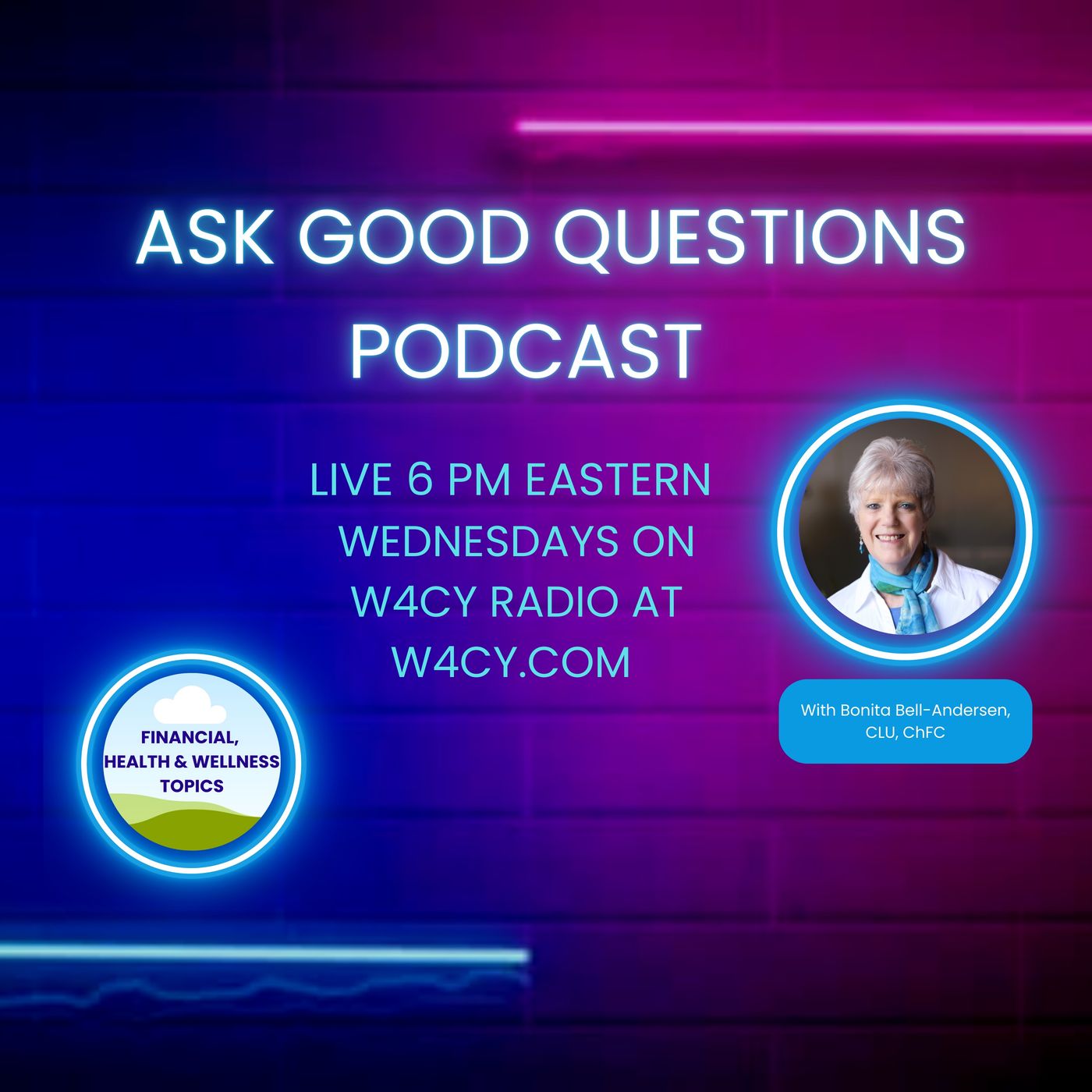
Ask Good Questions is broadcast live Wednesdays at 6PM ET on W4CY Radio (www.w4cy.com) part of Talk 4 Radio (www.talk4radio.com) on the Talk 4 Media Network (www.talk4media.com). Ask Good Questions is viewed on Talk 4 TV (www.talk4tv.com).
Ask Good Questions Podcast is also available on Talk 4 Media (www.talk4media.com), Talk 4 Podcasting (www.talk4podcasting.com), iHeartRadio, Amazon Music, Pandora, Spotify, Audible, and over 100 other podcast outlets.
Become a supporter of this podcast: https://www.spreaker.com/podcast/ask-good-questions--6441735/support.
0:02 Welcome to the Ask Good Questions podcast, broadcasting live every Wednesday, 6 p.m. Eastern Time on W4CY Radio at W4CY. Com. This week and every week, we will reach for a higher purpose in money and life, as well as a focus on health and wellness. Now, let's join your host, Benita Bell Anderson, as together we start with Asking Good Questions. Hey, and welcome to the Ask Good Questions podcast. This is your host, Benita Bell Anderson, and you may be wondering why I'm all dressed in black today. Well, we have a very special guest today. We are going to talk about all things dark web. We're going to talk about all things identity theft areas and... AI voice cloning and all these things that are happening all around us right now. And we're going to find out what to do about it. To introduce my special guest today, we're going to play a video about him.
1:17 You can roll it, Juan. Welcome to the golden age of scams. It's getting worse, it's not getting any better, and there's a reason for all of that. I don't know that the general public will ever be able to tell the difference between real or fake. Today, AI-driven predators weaponize this vulnerability. Using synthetic media, voice clones, deep fakes, they hijack our internal hardware, turning our greatest evolutionary strengths into predictable security liabilities. And there's a reason for all of that, but there is a solution at the end of the tunnel and it begins with leadership. Robert Siciliano is a cybersecurity analyst, identity theft expert, author, and president.
1:59 And CEO of the online resource Safer.me. He is a good guy hacker who has been for over 20 years an expert that the media has relied on to tell the story about cybercrime and identity theft and preparing for that. He's a five-time New York best-selling author, which is pretty incredible, and he's appeared in countless media outlets from CNN to the Wall Street Journal. to even the Howard Stern Show. He is also a 13-time Boston Marathoner.
2:44 His examples were things that happened to us. Every single day that really resonated with me. Today, AI allows for high precision impersonation at scale. You go on Facebook Reels or YouTube or any site that's producing video, tools like Gemini, HeyGen, they're producing perfect AI clones. Whether, you know, deep fake is one thing, just an AI clone, or just any video that's produced from scratch, you just don't know the difference. There's no such thing as 100% security. Nothing is completely unhackable, especially anything that's wireless is always going to be a vulnerability. And AI is also automating the grooming process using what we call normalizing dialogue to build rapport and exploit people like it never has, like humans never have been able to do at scale. A deep fake is an image, video, or audio recording that has been convincingly manipulated or entirely generated using AI, specifically a branch of machine learning called deep learning. You and I have been consuming information in the form of media all of our lives. But now all of this media has been corrupted, and we don't know who or what to trust.
4:00 We made cybersecurity interesting and not dry. Criminals are using what we call neural puppetry to create these perfect lies by scraping just seconds of audio from social media. And what this does is, is it weaponizes our biological default to trust, essentially making deception feel 100% human. The human blind spot is a psychological instinct to trust what is familiar to us. The cognitive gap or biological trust overrides digital suspicion, leaving the door wide open to all kinds of fraud and AI deception. Criminals exploit our human blind spot by weaponizing the brain's evolutionary mandate default to trust.
4:47 It's a shortcut designed for social efficiency. AI-driven defakes perfectly mimic it. that because our minds use what is called fast categorization heuristics they cloud our judgment and cause us to overlook the tactics and intentions of deception we. Did a great job of taking complex topics that would usually be a little unapproachable and breaking them down into easy to understand and actionable items that you can do at home to protect. Yourself The Strategic Human Firewall blocks deception. The foundation of this Strategic Human Firewall is what we call the AAA protocol. It kind of stops fraud dead in its track, even when your emotions are kicking in. It is your break the fake playbook. Essentially, analyze, which means recognizing manufactured urgency.
5:40 Security is not much different than physical health. We need to be engaged in basic security practices the same way that we need to be engaged in basic physical and mental health. The part that I'm most excited about implementing at our credit union is developing the human firewall. Awareness is key, and security awareness training is on the forefront of most IT security professionals' minds. The moment I request a man's secrecy, take immediate action, stop, your brain is moved into emotional reaction. Take a breath to move back into analytical thinking. Authenticate. Identify what we would call the digital mask. Those who are aware and informed and are considered leadership at some level that have new information that understand what risk actually is and can change their behavior ever so slightly by adopting a AAA protocol, engaging in basic one-on-one strategies like password managers and two-factor authentication and passing that knowledge on to others. You're good. You become that tougher target.
6:46 Especially with the state of the world right now, it's really emphasizing the importance of being proactive and staying on top of your security. So it's up to us to kind of stop what we're doing right now. Otherwise, it's just a matter of time until they get you. Security is always being on your toes, always being aware. Security never sleeps. It's 24-7-365. As crazy as it sounds, don't worry about any of this. But do something about it. The worst thing you can do is nothing. I think everybody should hire that guy.
7:29 I know. I think so too. I mean, he's fantastic. Robert, welcome. I love that. I think, boy, that is spot on. And we are going to talk about those things today in the time that we have remaining here. So I'm going to get right to it. So you say that we have moved from clumsy lies or clumsy scams to perfect lies. What do you mean by that? Yeah, so AI, as wonderful as it is for so many different reasons, has really made it... It is the de facto tool that bad actors are using today. They understand the power of it, and they understand how it can be used to manipulate us. And so what it's truly done is AI has really stripped away the clumsy red flags of traditional fraud. Essentially, in the past, criminals relied on what we would call blunder force phishing, essentially mass blasting emails riddled with scammer grammar. Today, AI allows for what we call high precision impersonation at scale. So criminals now use what we call neural puppetry to create perfect lies. So by scraping just seconds of audio and video from social media, They use voice clones and deep fake video to impersonate a trusted source, like, say, a spouse or a CEO, an attorney, your kid, with 95%,
9:00 if not more, accuracy. And what this does is it weaponizes our biological default to trust, which we can certainly talk about, making the deception feel 100% human. Yeah, I mean, you're basically saying that Smart, careful people are still falling for this. And that's the human blind spot, right? Yeah. So I speak to victims of crime all the time. And I would say 100% of the time when I have a conversation with a victim of some type of fraud, they say, you know, I kind of knew something was going on. I kind of knew something was wrong. And then they say, and I can't believe how stupid I was for being victimized, for being scammed. And my response to that is, no, you're not stupid at all. What the bad actors have done is truly they've weaponized our default to trust. So I call it the human blind spot.
9:57 And what that means is that they know that. we trust by our nature. Right. So the human blind spot is our trust. biological and psychological instinct to trust, right? It's that cognitive gap where biological trust overrides, you know, digital suspicion, leaving the door wide open for all kinds of fraud. Consider it like this. Like, We as human beings are what is considered an interdependent species. We are dependent upon each other for our survival. You know, we need each other. We are a social creature. And the basis of that survival is that we got to procreate. Okay. And the basis of procreation, you know, getting together is that the man and the woman got to trust each other. Well, that interaction isn't going to take place. Right. And so as a result, that most vulnerable state that we are in procreation requires the utmost trust. And so throughout the day, week, month, year, all day, every day, the people that you come in contact with, your DNA says, I want to trust you.
11:03 Right. And even when somebody is lying to you, your DNA says, I want to believe you. And so when the phone rings, you get a text message, you get an email, we are compelled to believe the lie. We actually have to make an effort to kind of stop what we're doing and, you know, turn our BS radar on to seek out, you know, is this person worthy of my trust? Well, one of the things you mentioned in the very briefly in the video, you mentioned urgency, right? And that seems like scammers have always used urgency in the past, but I think it's been taken to a new level.
11:46 Yeah. So, you know, 15, 20 years ago, you'd get a phishing email riddled with scammer grammar, you know, typos and such. And it'd be like, oh, if you don't respond right now, your bank account's going to be closed. Right. Or if you don't respond right now, you know, your credit card is going to get canceled or you're going to lose your Medicaid benefits or whatever the case might be, you know. And that is a form of manufactured urgency. Today, that might look like, you know, something as simple as you get a text message from the Registry of Motor Vehicles that says that they have you on camera blowing off a red light. You didn't pay the ticket and you're going to lose your driver's license unless you pay by credit card or Bitcoin via this link. Manufactured urgency. Now, they're lying. And it's an urgent request to do this now or else. And I see 10, 15 scams a day and the majority of them have some form of urgency that, you know, if you are just kind of like reading it and you're not really like deciphering whether it's real or fake, like immediately, like you can actually get a little anxiety from it.
12:54 Yeah. You know, like it's designed to create what we call like cognitive tunneling. So cognitive tunneling is when like something affects you emotionally, right? Manufactured urgency. And your brain is like just focused on solving or fixing that one problem and You know, that cognitive tunneling is like, you know, your grandchild calls you and says, hey, you know, Nana, it's me. It's me. And you're like, Johnny. And he's like, yeah, Johnny. And you're like, well, what's going on, Johnny? I'm down in, you know, Mardi Gras with my friends and my buddy. He got a bar fight and I tried to break it up. And, you know, I got arrested, you know, even though I didn't do anything wrong. And I need you to wire some money down here to bail me out of jail. And you can't tell my dad. And so like Nana is like, uh, okay, so, uh, what do I got to do? Because all she wants to do is, you know, take care of a grandchild and, um, cognitive tunneling kicks in. And as ridiculous as that thing sounds like that works.
13:52 Wow. Well, basically I think what you're telling people is we need to train ourselves to step back. Yeah. Right. And that's analyze. Yeah. Yeah. That's stepping back as a process that I call, um, and they mentioned, we, I mentioned it in the video, it's called the AAA protocol. So the AAA protocol is your break the fake playbook, so to speak, right? So AAA is analyze, authenticate, and then act. Okay. And really like analyzing and authenticating is in fact acting, right? So AAA protocol is recognize, number one, analyze, recognize manufactured urgency.
14:34 Like the moment you pick up the phone, get an email, text message, like the moment there's like some type of urgent request, that already is BS, okay? The moment that request, you know, demands immediate action, it might demand secrecy of some sort, like don't tell anybody or else, your brain is moved into emotional reactions. And so, like you said, you got to kind of take a breath, step back, move into analytical thinking. What is actually happening here? via this manufactured urgency, and then spend some time and energy and effort authenticating who the person is on the other end of the line. Treat every digital communication as a potential breach or vulnerability. Look for the red flags of whatever this request might be. And then the third and most important thing is when you act, that means you're executing what we call out-of-band communication. So, for example, never use like if they call you on the phone, never call them back at that number. You know, even if caller ID says it's your loved one, don't necessarily reply to the phone call. Go to your contact list and call the person at the trusted number that you know, like manually dial it in. Right. Google it if necessary.
15:58 Email them at an email address that you know is legit versus like replying to that scamming email. Right. So using out of band verification means never using the contact information provided in that suspicious communication. Right. Hang up and call the person back on a trusted pre-validated number that you know is legit. Well, let's talk about very briefly another thing that you call pig butchering. Why does it work so well on people who are lonely or recently widowed? What in the heck is pig butchering? So, you know, if you think like pig butchering, like we kind of know what that is. Just the reference to it is like he's butchering a pig. Yeah.
16:38 Right. Well, pig butchering in the scam world is basically fattening up the pig before slaughter, which means fattening up the human in such a way where I get them all pumped up, get them to invest all kinds of money. before you basically completely rob them of it. Wow. Okay. So pig butchering is like, for example, we get those wrong number text messages. You must get them. I do, right? Yeah, I do. Hey, Bonita, this is Robert. Like, we're supposed to have lunch tomorrow. And you're like, Robert, Robert who? And, you know, Robert responds or Benita responds or whatever, like saying, hey, I'm sorry, do I have the wrong number? And they're like, oh, hey, you know, I'm Isla. I'm from, you know, Coral Gables, Florida.
17:29 Where are you from? And the dialogue begins. Wow. And what they're trying to do is they're trying to lure you down their, you know, rabbit hole. They're trying to get you to just like respond to anything. And what they really want is for you to communicate with them like all day, every day. And to them. And that actually happens. So that would fall into the category of people that are. Lonely, recently widowed, that type of person. Yeah. You know, so did you know that right now as we speak, 25% of all of humanity all over the world, 25% are lonely, meaning that they wake up lonely throughout the day. They're starving for companionship. And when they go to bed, they're lonely. And they wake up feeling the same way. And that loneliness, they call it the pain and ache of loneliness. And it's equated similarly to say hunger pains. Like hunger pains are actually like designed to when you feel hunger to forage and find food. Why?
18:42 Why do you suppose that we need to forage and find food? Like why? Why? Because our body needs to be supported. And ultimately, why does our body need to be supported? Because otherwise we would die. And if we die, we cannot do what? Anything. Procreate. Procreate. Okay. We couldn't do that either. That literally is the basis of everything. Like when I tell you, it is the fundamental purpose why we are on this planet. Like that is it. Nothing else matters. Like when it all comes down to it, Without procreation, we would fail to exist. Yep. And so most fraud revolves around that one fundamental. And that one fundamental is we will do anything to procreate.
19:30 And that means we've got to eat to satisfy our body so that we can live another day to procreate, right? Got it. Hunger pains are designed to keep us alive to procreate. Loneliness, that pain and ache of loneliness is designed so that we will find a mate to. Procreate. Yep. Yeah and they know this and they know that wow the same way that you are like really hungry and you get hangry that you like do almost anything to find food and like keeping in mind that like here in the u.s like here in our country like pretty much like most everybody we have an abundance of food right we don't necessarily most of us And I know that there's a part of the population that does in fact starve, but most of us in first world countries do not experience hunger.
20:17 Right. You know, like, like me in my own life, like I can't go five minutes without there being food stuff in my face. Like wherever I go, you know, there's food everywhere. It's just constant, like too much, actually. That being said, like, hunger is a motivator and the pain and ache of, of, of loneliness is a motivator. And they know that if they, they motivate you through satiating that loneliness, that they can gain your trust. Amazing. Well, let's move into the family defense plan. Um, once again, The AAA protocol, the Analyze, Authenticate Act, about that, I want you to go through those three steps again. And then the Family Challenge Code. Let's talk about that as well.
21:04 Yeah. So, you know, like when you have kids and, you know, there might have been like back in the day when you had kids that, you know, if they were, you know, walking home from school, which I used to walk home from school. Yeah, me too. And, you know, barefoot in the snow, right? Yeah. And the kids today, like they get, you know, driven, which is, I guess, you know, fine. Um, I've spent a lot of miles driving my kids to school. Yeah. All that being said, you know, back in the day, like there would be like a dialogue that you're supposed to have with your kids that, you know, if anybody like, you know, uh, is, you know, comes up to you and, you know, on the way home from school or on the way to school or whatever, and says, you know, Hey, your mother told me to pick you up. Well, that person should know the code word. Yeah. Some families had that dialogue. Some families didn't. I had that dialogue with with with my dad and my mom. And so that code word is something that like we should still have today.
22:10 So if you get the phone call by a loved one that says, hey, I'm in a situation where I need help. OK, loved one, what is the code word? So I know it's you, because today with generative AI, you know, chat GPT. you know, Gemini, you know, Claude, um, those tools have the ability to create, uh, audio and video cloning you and I to sound and look exactly like us. Yeah. Which is those, those tools are readily available and it's perfect. Like the, the audio is you and I are incapable of telling rail from fake when our voices actually cloned. Like it's, it's, it's kind of awesome how it works. And, um, As a result, moms and dads are getting phone calls, and they hear in the background their loved one, son or daughter, screaming for help.
23:06 And it sounds exactly like their loved one, their kid, because essentially it is a computer-generated version of it that is perfect. Right. And so as a result, when that mom hears her daughter screaming over the phone... And then a guy gets on the phone and says, I have your daughter. I've kidnapped her and you've got to pay me or else. Now that mom who hears her daughter screaming, her general first reaction is not, yeah, this is a scam. Because when she hears her daughter screaming, her heart like just begins to explode out of her chest and cognitive tunneling kicks in. And now she's all about, you know, doing what's necessary to get her daughter to safety. And that is a legit scam that we're seeing more and more. Wow.
23:58 And it works. And it's lucrative. And I'm reminded of a scam like that that happened recently in California. And the mom gets the phone call. Here's a daughter in the background. And the daughter's like, mom, I'm so sorry. I'm so sorry. I didn't mean for this to happen. They took me down to Tijuana. They said they're going to drop me off at the grocery store. Just please just do what they say. I'm so sorry that this happened. Like all that came out of a pre-generated voice recording. Wow. And the mom immediately like, gets the guy back in the phone. She's like, what do I got to do? And for the next five hours, this mom drove all over town to every bank account that she had to a Bitcoin machine, deposited cash into a Bitcoin machine, wired money via Western union, like for five and a half hours, pure terror. This mom went through. And then when like the, when, She said to the scammers, that's all I have. That's all I have. I can't get anything else. Where's my daughter?
25:01 Where's my daughter? And they said, well, we'll drop her off at the grocery store. The mom goes to the grocery store and the daughter's not there. And the mom, like, you know, doesn't know what to do. So she calls her daughter on the phone. Are you okay? I'm at the grocery store. I'm waiting for you. Are you okay? Did they let you go? And the daughter's like, mom, I'm at work. Why? What's going on? What are you talking about? Why didn't she call her daughter first thing? Everybody asks the exact same question. And the reason is, is because when your daughter calls you on the phone, what do you do a hundred percent of the time? What do you do? Well, I'm going to talk.
25:42 Just talk to me. Yeah. That's what you do. Yeah. If your daughter called you in a screaming voice, what would you do? You're already on the phone. You could. Yeah. You hear your daughter's screaming voice. Your brain does not go, yeah, this is a scam. No, your brain goes, this is my daughter and she's in distress. That's how we are wired. That's it. We can easily say, well, why didn't she? Because why would she? You know what I mean? Yeah. And the reality of it is that's what most people should do is take care of the safety of their loved one. But the reality is today that should is, okay, I got to kind of take a step back now because what I'm hearing may not actually be my daughter's voice now because this is a real thing. Yeah. It's nuts.
26:37 It's awful, but it's kind of awesome. So, I mean, so one of. The things you talk about is hang up and call back on a number you trust. But if you're on the phone, I can see where that's a problem. Yeah. Well, the reality is the likelihood of your loved one being kidnapped. It's probably very low. It's extremely low. I mean, do you know anybody that's been kidnapped? No. Okay. And so I don't either. I mean, you see it here and there, like on TV, you know, it does happen, but the likelihood of it happening is like just so infinitesimal. Yeah. And so that said, I mean, it's still a problem, but not that big of a problem that, you know, that really what you should do is, okay, ask my daughter this question. Ask my daughter the code word.
27:29 Ask my daughter where we last vacationed. Ask my daughter the name of our dog. Anything at all. Anything that like, any knowledge-based authentication question to get more insight. But the reality of it is, there's like a 99% chance that it's just a scam to begin with. but kind of go through the motions and kind of flesh it all out. And really at this point, every single phone call, email, text messages that we get every day, all day long, we should be scrutinizing the person on the other end to determine if they are who they say they are. Whether it's a coworker, whether it's a bank, whether it's a credit card company, whether it's a loved one, we just cannot just by default automatically trust because of the human blind spot.
28:19 So one thing that families should do, everyone should do is have some kind of challenge. That should be something that we all set up like right now. Right. Got to have a code word. You got to have a family passcode. Yeah. Something that, you know, that you all know that isn't like posted on social media. That makes sense. You know, the name of our very first pet. You know, the college that mama went to school at, you know, a puppy's middle name, you know, something to that effect. Yeah. Anything easy enough that, you know, everyone's going to remember that in like as ridiculous as all this sounds, it's, it's significant. Not only did that mom lose five hours of her life, she might've lost like five years, you know, of her life because she, of her heart was so stressed out for five hours.
29:14 Yeah. And she lost almost six grand, you know? So, uh, the money's not the problem. You know, it's like, it's, it's, it's, it's, it's, it's what it does to a human. Like you get some PTSD from something like that. Oh no, no kidding. So once again, it's analyze, analyze what's going on. Yeah. Analyze what's going on. Recognize the manufactured urgency. The moment the request demands seek or immediacy, like your brain is moving into emotional reaction, stop. Then authenticate, treat every digital communication as a potential vulnerability, and then act. execute out of band verification, never use the contact information provided, you know, call them back in a pre validated number that you know is legit.
30:03 Right. Yeah. Well, hopefully, you know, if you're not alone and hopefully you have another way besides a phone, I'm just thinking if you get something like that on your cell phone, hopefully you have somebody else's cell phone that you could call. Listen, I say just like hang up and call them back. Yeah. Just hang up and call them back. You know, I mean, Look, let's just say... I can't even believe I'm going to get down this road. Let's just say they did kidnap your daughter. They're saying that they kidnapped your daughter. And that they want to get paid. Look, you hang up. That doesn't mean that she's immediately going to be executed. They still want to get paid. Right. That's their goal.
30:45 They still want to get paid. So they're going to take your call. Yeah. Yeah. So. Are there, I'm guessing that there's older victims that never report being scammed as well. Yeah. I heard like some number not too long ago. It was like, like, I don't know, like between three and $ 15 billion lost in 2025, which is like the largest number that the FTC has ever heard. And I'm like, that's it. Like, that's it. I would say it's like 10 times that. Wow. Yeah. So if someone realizes, so let's say somebody goes, oh my gosh, I've been scammed. What should they do in the first hour?
31:25 Number one, call the police and go to the police department. Depending on the method of payment, I would do what's necessary to claw that money back through whatever that method of payment was. Say it was your bank or credit card company or Western Union. If there was a Bitcoin machine involved in it, definitely call the local police department because they might go right down there and they might like unbolt the Bitcoin machine and bring it back to their office. Like I've seen that actually happen. I've literally seen that happen. You want to get in touch with local law enforcement as quickly as possible because they are in the best position to guide you. And in many situations, that guidance might involve confiscating a Bitcoin machine, might involve going to the actual bank with you, It might involve them getting on the horn with the local FBI office, depending on how much money was lost. And they may be able to do something too. So we have options.
32:25 We just have to exercise those options. Let's just be proactive and just not lose the money to begin with and recognize that risk today so that going forward, every time the phone rings, you get a text message or an email, you have a general plan of action of what to do if that inbound communication involves some form of manufactured urgency. Well, and I'm thinking too, that adult children should be, I mean, not only between spouses, but adult children should be having this conversation with their parents. Adult children should have a handle on their parents' wellbeing at all times anyways.
33:08 Yeah. No, And that's like, you know, their physical health, their mental health, their financial health. You know, like I'm checking into my dad. You know, I'm checking into my mom. I'm making sure that everybody's good. You know, I'm having these conversations with them all the time. You know, I want to know that they're all right. And then they also know that, you know, anytime they get a pop up in their computer that says it's Apple. And they've got to make a phone call to Apple because there's something wrong with their computer. I'm like, no, you call me. I'm the one that do. You don't call Apple. You call me. Well, but it has the Apple logo. I'm like, yeah, that's exactly what they want you to think. So you have these conversations with your loved ones. And you should also consider having a conversation about having some level of say over any time they want to move money. Yes.
34:03 Obviously that can be a sensitive topic for some people and some people will fight back on that. But you know, like there was a time in my family where my mother-in-law who at the time was like, you know, 80 ish. And she was engaged in some, um, poor decisions financially. And, uh, you know, like she had dozens of subscriptions and, to various ridiculous products and services that she did not need that, you know, she was signing up for at 3 a.m. And, you know, we're looking at the credit card bills and be like, what is all of this? Yeah.
34:43 Yeah. You know, and then, and then you see all these unopened boxes all over the place. Yeah. And so those are conversations that need to be had. And sometimes, you know, you find out $ 15, 000 too late, but that's still not that bad compared to what could actually happen. I've known of people losing high six and seven figures. Oh my. Yeah. So, you know, we as children have a responsibility to parent the parent at some point. Yeah. Well, Robert, we are just about out of time. Where can people find you? And what kind of resources would you like to direct them to? And what's the best next step for them?
35:29 Well, like many, I'm on the Google. So just search Robert Siciliano, S-I-C-I-L-I-A-N-O. You can find my website at protectnowllc.com. Again, protectnowllc.com. And listen, you know, I post on my blog generally every couple of weeks, maybe a little bit longer here and there. And I give it all away for free. Like, just read my stuff. And you'll see, like, there's just. I'm doing that. I read your stuff. Yeah. There's plenty of actionable strategies just by reading the past 10 blogs that I have. Yeah. And you'll know what to do. Sounds awesome. Well, Robert, our time is up. I can't believe it. It went fast. This is so important.
36:14 I hope everyone's going to take and set up a challenge word. Think about your protocol. And also, besides going directly and finding Robert on the web, there is a flyer on my website with his information where you can find him as well. So with that, Robert, thank you so much for joining us today. And thank you to everyone. I'm going to put my sunglasses back on. Thank you so much for joining us today on the Ask Good Questions podcast. And we will see you next time.
36:55 Today's episode is over, but we did ask good questions again, didn't we? Don't miss out as we broadcast live every. Wednesday, 6 p.m. Eastern Time on W4CY Radio at W4CY. Com. Join Benita Bell Anderson next week for more conversations with experts on finances, retirement, behavioral finance issues, health and wellness, and more. Until then, remember to ask good questions.


