Tame Your Money Monster: How Your “Sacred Wounds” Secretly Run Your Financial Life (and How to Take

 iHeartRadio iHeartRadio
 Spotify Spotify
 Amazon Music Amazon Music
 Pandora Pandora
 Apple Podcasts Apple Podcasts
 Podchaser Podchaser
 Deezer Deezer
 Audible Audible
 Youtube Music Youtube Music
 Spreaker Spreaker
 Podcast Addict Podcast Addict
 YouTube YouTube
 Castbox Castbox
 Podverse Podverse
 Podurama Podurama
 PocketCasts PocketCasts
 Overcast Overcast
 Goodpods Goodpods
 Fountain Fountain
 Podyssey Podyssey
 Castro Castro
 Castamatic Castamatic
 RSS Feed iHeartRadio iHeartRadio Spotify Spotify Amazon Music Amazon Music Pandora Pandora Apple Podcasts Apple Podcasts Podchaser Podchaser Deezer Deezer Audible Audible Youtube Music Youtube Music Spreaker Spreaker Podcast Addict Podcast Addict YouTube YouTube Castbox Castbox Podverse Podverse Podurama Podurama PocketCasts PocketCasts Overcast Overcast Goodpods Goodpods Fountain Fountain Podyssey Podyssey Castro Castro Castamatic Castamatic
What if the real reason you overspend, avoid your bank account, or stay stuck isn’t about discipline—but about old wounds? Doug Lynam (Marine → Benedictine monk → money manager) unpacks how “Sacred Wounds” quietly drive our money choices and why willpower-based budgeting so often fails. You’ll learn how the Enneagram reveals your predictable financial blind spots—and what to do instead. Expect practical takeaways, surprising self-awareness, and a path to real change.
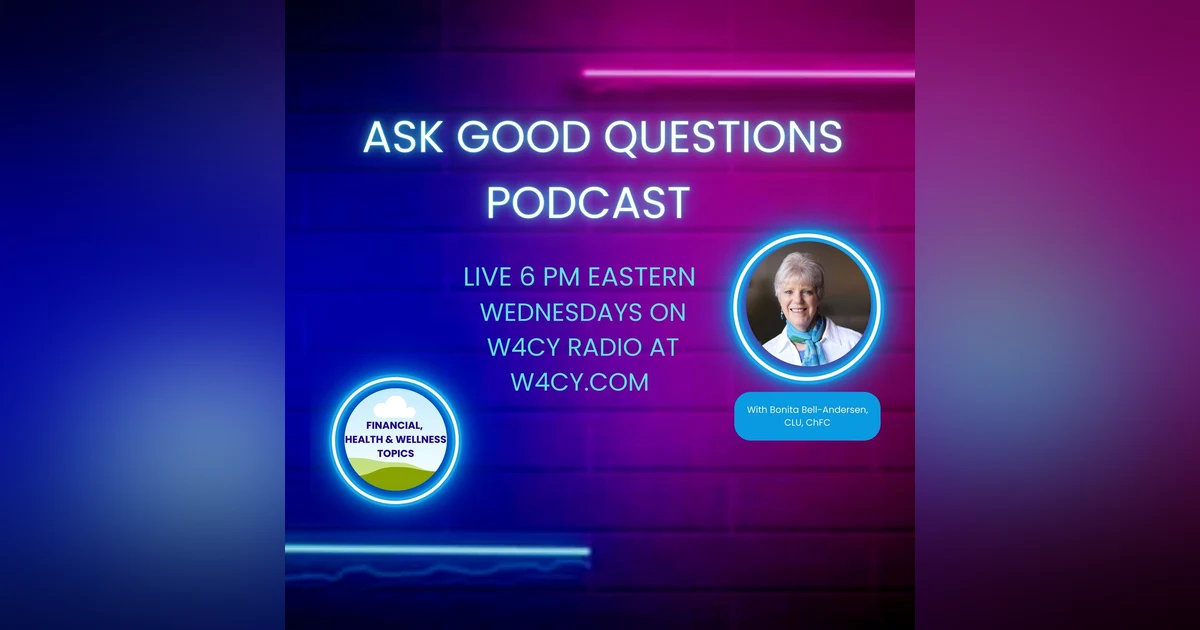
Ask Good Questions is broadcast live Wednesdays at 6PM ET on W4CY Radio (www.w4cy.com) part of Talk 4 Radio (www.talk4radio.com) on the Talk 4 Media Network (www.talk4media.com). Ask Good Questions is viewed on Talk 4 TV (www.talk4tv.com).
Ask Good Questions Podcast is also available on Talk 4 Media (www.talk4media.com), Talk 4 Podcasting (www.talk4podcasting.com), iHeartRadio, Amazon Music, Pandora, Spotify, Audible, and over 100 other podcast outlets.
Become a supporter of this podcast: https://www.spreaker.com/podcast/ask-good-questions--6441735/support.
0:00 The topics and opinions expressed in the following show are solely those of the hosts and their guests and not those of W FOURCY Radio. It's employees are affiliates. We make no recommendations or endorsements for radio show programs, services, or products mentioned on air or on our web. No liability explicitor implied shall be extended to W FOURCY Radio or its employees are affiliates. Any questions or comments should be directed to those show hosts. Thank you for choosing W FOURCY Radio. Welcome to the Ask Good Questions Podcasts, broadcasting live every Wednesday, six pm Eastern Time on W four CY Radio at W four cy dot com. This week and every week, we will reach for a higher purpose in money and life, as well as a focus on health and wellness. Now, let's join your hosts, Banita Bell Anderson as together we start with Asking Good Questions.
1:01 Hey, welcome to the Ask Good Questions podcast. I am so glad that you're here today, and man, have we got a guest that is going to turn you upside down when you think you know, when you're thinking of money and monks, believe it or not. So with that, I want to get going because we've got a lot to cover. I'd like to invite Doug Lineum to the podcast stage. Welcome Doug. Thanks great to be here. Well, let me tell you a little bit about Doug. This is kind of a really interesting thing. He his career path has been wilder than what he calls a roller coaster designed by Salvadar Dolly on a sugar high from the Marine Officer candidate school. I want to know somewhere in here, I want to know why you left that to twenty years as a beddedicting monk before urging from Monaska life to become a financial advisor and a business coach and a keynote speaker and a best selling author.
2:06 He's got two books, from Month to Money Manager and Taming Your Money Monster nine Pass to Money Mastery. I'm getting a lot of m's in there, Doug. Now, this is with the Enneagram, which he's going to talk about revolutionizing how we understand our relationship with money. This is in my twenty five years in the financial advising world. Behavior has been one of the biggest things that I've seen. He's also got a popular ten X talk that has had over four hundred thousand views. His insights have been featured on CNBC, in the New York Times, and he's now a financial advisor with the Innovative Advisory Group. And his unconventional journey earned him a private audience with Pope Francis in twenty twenty two and established him as a leading on the intersection of wealth and meaning and purpose.
3:05 So anything to add to that done. Oh, it's a pretty good start. I think we just get going with that. Yeah, I would say, so, well, you've lived like three lives, marine and the monk and the money manager. What's the through line? What is it that's connecting all of those three things? Oh? Wow, I guess the through line is I guess a life of service, you know, trying to find different ways to live a life of meaning and purpose and trying to find ways to Yeah, I think those deeper philosophical questions of you know, why am I here? And what's it all about? It's being curiosity is probably a through line, and then adventure is another through line, and then just always looking for that way of using my talents to serve others.
3:57 So let's begin with the whole thing. What you were on your way to becoming you were in the Marine office or training school. So what happened there? Oh, it was great. I had a blast. You know. I graduated, taught my class, and was thinking about making a career on the Marines. Uh. I finished my training and then to be an officer, you need to have your training completed, and you also need to have your college degree. And I saw the year college left, so I sent you back to school. So I kind of a year pause to sort of sit and think about this a little bit about what I really wanted to do with my life. And I kind of realized that unresolved anger issues and high explosives were probably a bad combination. So I didn't need to go blowing people up around the world because of my unresolved emotional issues. And you know, I left the Marines because I thought, well, if I'm going to leave this life, what would be a higher calling? What would give me the structure, the discipline, the spree of core, the camaraderie, and maybe a higher sense of purpose. And that's when I, of course, any self respecting person would do is go off and join them on.
5:00 It was. A great way to flabber. Ask my parents. They were really, really a great way to rebel against how I was raised and annoying them immensely, which I did a good job of doing over the years. Much I'm sorry, Mom and Dad, But anyway, so that's kind of how I got got into the monastic life and was really looking to escape the world of money and materialism forever. But obviously things took a bit of a turn. Well you were there for twenty years, yeah, twenty years? Yeah, yeah, so wow. Well when people here from month to money manager, that seems like a contradiction. Right, Well, I guess what I learned. I guess what I learned the monastery is that money and spirituality aren't aren't separate. You don't need to divorce yourself from the two.
5:49 And then in fact, when you when you reject money for the wrong reasons, it can be as unhealthy as being greedy, greedy and averishous for the wrong reasons as well. So they just have two sides of the same coin. And that you know, we have a lot of biblical admonitions against greed and wealth, which are which are understandable. But when you're a little more deeply about it and you understand maybe even the historical context in which some of those those statements were made, then you kind of has a little more nuanced to it and realize that actually, when you when you reject money completely out of hand, then you disempower yourself and you and you, you're giving up one of the best tools we have for love in our world. And so you can't you know, because a couple of years after I got to the monastery, what really kind of turned things around for me is our community went bankrupt. And so after the monaster and bankrupt, somebody had to sort that mess out. And I was the most junior monk at the time, so I kind of naively raised my hand to take on that project.
6:50 And you know, I couldn't do a worse job than my predecessor, So the bar was set pretty low, even though I was financially illiterate at the time and really didn't know what I was doing. But I got in there and figured out and realized I had some skills to be of service. So that's kind of how I started off into my financial journey. Well, it was just kind of like the universe put you where you needed to be. Yeah, and yeah, so you can't you can't feed the hunger your clothes naked or healed the sick without some money in your pocket. And that's what I realized in the monastery is that, you know, we were all smart, well meaning, well intentioned people with good hearts, but we had these what I call money monsters, these these negative attitudes around money that really disempowered us and put us in a deep financial hole and prevented us from being able to really be of that tool for love and service that we were called to be. There were so many people we wanted to help, so many the things we wanted to do, but we just couldn't because of the financial constraints. That just felt like you're shackled and handcuffed because you just you can't do anything in a modern economy without without money in your pocket.
8:00 Right, And what the scriptures actually say, it's the love of money. It's not behavior, it's a behavior. Is that that is the problem. Well, yes, and if so, I actually have a whole chapter on that in my first book, From Monk to Money Manager. And when you dig into the Greek it turns out in ancient Greek there's five different words for love, and so what we're talking about the love of money, there is a very avaricious kind of love. And so what without without boring your your your audience with a linguistic lesson, I'll just say there's higher forms of love, what what we would call in Christianity agape love, And how do we bring that higher form of love into our money? Because maybe it as a philosophical thought experiment, regardless of your faith tradition, like whatever your set, whatever you whatever, you know your sense of the divine is like, well, if I can use the God language for a moment, where is God?
8:52 Not? Where where is and and so how can God not be in our financial life and and be in other parts of our life? It doesn't make any sense that we arbitrarily divorce those two. So it's really about bringing a higher form of love, not because only one word for it in English and it doesn't translate well. And so it isn't just the love of money. It's that greedy, avaricious kind of the ebbets are scrooge mentality towards money that wolf of walts exactly. So what do you think is the most common money struggle that you see that isn't actually doesn't have anything to do with math or budgeting.
9:34 Well, that's a deep question that goes back to the enneagram, which we can get into. But Okay, the simple answer is there isn't a simple answer. It isn't like there's one thing that we all universally struggle with. It really depends on our personality type, and our personality structure determines how we kind of view all of reality, but then also determines how we have a how we relate to money and healthy and unhealthy ways. Well, I you know, as I you know, I've been reading your book and thinking about this. I went through this terrible divorce about twenty five years ago, and I did a really good job of self sabotaging myself financially, and now I can look back at it and I can just see all kinds of you know, that was all wrapped up in emotions and my psychological state of mind and everything. It was really interesting. So with that, I'm thinking, let's get into you. You're talking about sacred wounds.
10:37 So if you could define what's a sacred wound, how do they form and why do they show up in our finals? Did you have a sense of your enneagram type by chance from what you've looked at the book, or. I knew you were going to ask me that I didn't know. I didn't do it yet, I'm going to. But we can dig into you a little bit, maybe do a little armchair diet coaching and figure out your monsters, and that might teach your audience a little bit about how the system works. So your question of the sacred wound, so the way it works, and so what I've really tried to do. So the enneagram for the audience's members who aren't familiar with it any In Greek means nine and Graham means drawn, So anagram is a big fancy word for nine things drawn together and what they represented.
11:25 The nine sort of archetypal personality structure ego defenses that we can have. So if you think of a color wheel, if you take a circle, and you do have a giant color wheel, you can basically divvied up into nine quadrants, and then our personality sort of fall on a range somewhere in each of those quadrants. And so the way it works is your personality has a lot of parts to it, and the anagram doesn't explain everything about who you are because you have a nature component your DNA. But then you have a nurture component, and so the enneagram helps explain the nurture part of your personality, how your childhood environment shaped your ego defenses that allowed you to survive the biggest threats and the biggest challenges that you face in that childhood environment. So it's a little complicated.
12:12 I'll try to get too technical with it, but essentially, think of it like this. When you're born, you know, there's a physical umbilical cord that gets cut with a sharp knife, right, and then you're physically separated, but we form what I call an egoic a psychological umbilical cord that forms between us and our caregivers, and that egoic codependence allows your parents to do most of the driving of your ego in the formative years of your life because you're not really sure what this reality thing is yet. And then you enter into what we call the individuation and differentiation stage and childhood where you begin to separate from your parents, and that psychological umbilical cord has to be cut, and unfortunately it help just like the physical umbilical cord, it has to be cut with sharp negative emotions, because positive emotions would reinforce that connection. Back to your caregivers, and it's typically gets cut through the way boundaries are set around us and our child. That the way we receive the nose, you know, don't touch the hot stove, don't kick the dog, don't bite your sister. You know, there's some boundaries saying that has to happen. And that's the basis of what I call your sacred wound. And so those boundaries are often set through negative have to be set through negative emotions. And we know from the work of an affect of neuroscientists by the name of a Yak panks Up, and what he discovered, you know, many years ago, is that in all mammals there's three core negative emotions and it runs off the limbic system of the brain and the brain stem, and so all mammals are running off of the All the negative emotions
13:45 are off of these we call them the b I call them the big three negative emotions. That's going to be anger, grief slash shame, so grief for shame, and then the third one is going to be fear, So anger grief and shame or anger, grief and fear. Are those three, those big three negative emotions that we encounter throughout life and in childhood that do the cutting of that psychological umbilical cord. So if you're going back that the color wheel metaphor, if you think of a circle and you divide up into three big chunks, you've got the anger quadrant, You've got the grief, and then you've got the fear quadrant. And then we can divvy those three sections up three more times because when we experience those negative emotions, we can process them in one of three ways. We can internalize that pain, which is kind of like giving yourself an emotional wedgie. You can externalize that pain, which is like having a food fight with the world, or you can have both at the same time.
14:42 So there's three core negative emotions, three ways to process them or deal with them, and that's what gives us these nine archetypes of personality in the enneagram. So that is your sacred wound, is how that psychological mbilical cord for you got cut. And then the punchline. Why that's all Why do we care about all that? Is basically because from that wounding that's happening in a pre conscious stage, it creates your greatest unconscious fear. This is the fear whatever, whatever fear that that wounding creates is then kind of come of the chassis of your ego. If you think of like your car you're driving in, it's the it's the shape of that chassis that you're driving through the rest of life, and that your ego is trying to protect you from.
15:25 Wow, this is this is awesome. I mean, you're making me think of all kinds of things, you know, and I'm sure everyone that's listening is doing the same thing, thinking of the different things that have happened to them in their life. What do you think are a few classic science that that somebody's many behaviors being driven by a sacred wound that the thing that I mentioned to you probably. Was then yeah, well, let's see if we can diagnose your type, and then people can follow along and maybe figure out their type as well. They'll kind of give a little sense of it because that probably put have time to go through all the nine types. It's quite complicated because inside each type is an infinite amount of variety, and there aren't just nine types. There's subtypes and subtypes, and it goes down and down, so there's a lot of customization. If you will, But just to take a moment if you're listening and be to do the same is think about your child, think about your teenage years, your twenties, and even now, because as we age, we mature are type it's not a static system. We do mature as we age and hopefully grow into a healthier relationship to this stuff. But when you were younger and even now, in your darkest emotional moments, which emotion do you tend to feel more of? Do you tend to feel more anger? Do you feel more grief slash shame?
16:47 Or do you have more fear? Well, I'm thinking of things that happened to me in my teenage years that anger. Anger. Okay, So if you're in the anger triad, then there's three ways again we can process that anger. I mean we can if you externalize it. So I'm gonna give you three, these three choices to think about and see which one, if any of them fit you. So they have numbers. These are in the anger try to eight one in eight nine and one. And the numbers don't mean anything. They're just placeholders. But so they're not they're not value, the signify any value. So Type A is the has their sacred wound of anger that they've externalized, and they have a deep sense of injustice. But what it does is their anger is sort of I use car metaphors because I think it's helpful for people, and so think of I think of type as we call them the challenger, or I call them the hum v of egos, because they're always sort of pushing against the boundaries and limitations of reality around them, because their greatest fear is being harmed or controlled. So they're they're kind of the take charge. They like to be at the top of the food chain wherever they are, and they have this need to kind of combat against others instinctively as a way of self protecting. So we say for a Type eight, there are their ideas the best defense is a good offense. So they're kind of the challenger.
18:17 I call them the hummer because they can kind of run over obstacles in front of them very easily. But they tend not tend not to be very few efficient with their opinions. So, for example, Donald Trump is not to be political, but he's a classic example of a go get it type, hard charging Type eight, and so is doctor Martin Luther King Junior, these are These are both examples of eights. So that's one choice. See if that strikes you at all, and then we'll jump over to type one. And now type ones. They take that anger and they internalize it. They directed it themselves versus out the world, and they what that does is it creates their greatest fear of being bad or defective. So the strong inner critic in their head, it's always telling them to be a good boy, be a good girl, do it right. And they they will often call them the perfectionist or the improver. They can always see the flaws in themselves and other things very easily. But I call them the BMW of egos because they're sort of precision engineered, but they take a fair bit of maintenance.
19:20 So those are the two two choices. And then in between the eight and the one for on this color wheel is type nine, and we call them the peacemaker because they have this internalized anger at themselves for not really being able to meet their needs in childhood, but then this externalized anger at the world for not really meeting them either, which they're always tamping down. They're the greatest fear for an eight. It's a little weird it's say it's a loss of wholeness. It means they're afraid that if their anger ever came out, it would erupt and kind of blow them apart. So they kind of go on to get along, to be very easy going, very peaceful, loving people, but they don't like conflict because they're afraid that it would cause their anger to erupt and really, you know, could cause damage to themselves or others.
20:06 So that's what we call call the peacemaker. I call the r V of egos because they kind of like to chill out, you know, and hang out the campground sometimes while the world's passing them by. Any of those strike you as possibilities, you know. I'm just thinking, yeah, I know that I've there's been a lot of you know, not wanting conflict. Uh. In the being out of control the teenage years, there was some there was some things that happened around me being control, being not in control at all. Uh. It's had to do with some young men and and just being really really angry about what happened. And and then you know, I think that that you know, it translates into uh a divorce. You know, after twenty five years of marriage and feeling smushed into the ground and again no control and just wanted to and you know, so you know, when I think of myself, it's like I've always wanted, you know, I want to be the best that I can be. And and the thing and the thing that I think about, like the stuff that the really upsetting things that happened in my youth. I never told my parents, never said anything. I was too ashamed and I was too mad, and I was angry and I was it
21:36 was really scary as well, and I never said anything to anybody, just and like you said, tamped it down down. Yeah, so you probably don't get angry often, but when you do, it's is it pretty pretty explosive when it happens. Yes, I'm pretty even keel, I'm pretty, you know, I'm pretty, you know, and and most of the time, but if I but if something happens that I just I And it doesn't happen very often, right, But but yeah, I can see that so. More in the nine. You think you're more in the nine category that yeah, probably okay. So so then if if if you're a nine, then what we say with the so then we're added more complexity to an already complex system. Uh, I've layered on top of the anagram what I call the attachment theory of money, which is identical to the attachment theory of relationships, just applied to your finances. And so what it What it basically says is that there's two kind of core unhealthy ways that we might relate to money. One where we're anxiously attached to it. Right, that's kind of again the Ebenezer screwge or the the if you think of the show Succession or Billions, people who's whose anxiety around money and need for it is so high that it creates suffering for themselves or others. Or you can be avoidant around which sounds like maybe you had some avoidance issues in your youth where you're sort of unconsciously pushing away or self sabotaging your financial life because you know, because of all
23:08 the negative emotions it brings up, you don't want to deal with it. You tend to find ways to basically not take responsibility for your financial life in some meaningful way. And so we each type expresses those that anxiety or avoidance in different ways, and it shows up in different areas of our financial lives. So most of us aren't just all one type of anxious or avoidant. It might show up in different areas of our financial life. So there's what I call the four pillars of finance, and the four pillars of finance are going to be earning, saving, investing, and giving. So earning, saving, investing, giving. So we might be like an anxious earner where we want to make a lot of money, but then we might be an avoidant saver because we spend it all on stuff. Or we might be an anxious investor but then an avoidant giver.
23:55 So there's different We can mix and match these. But the the money monsters for tight nine, I call them the spud and the dud. So the spud is sort of the financial couch potato. They don't want to deal with the conflict that the financial life is creating, so they kind of like they treat their financial life kind of like the treadmill in the corner that they never get to. It's just it's there. But they sort of neglect their financial life in a kind of a just through avoidance and ambivalents or sometimes with ninees. What you see is what I call them the dud, and that's the one who they really want. They care about their financial future and they want to take appropriate action. But because that fear of conflict or that anger is driving them, they sometimes run around a flory of activity and they do a lot, but nothing much ever seems to happen because they're never getting to the conflict that they're avoiding in the first place. So spuds and duds is one are the types of the nine. And I don't know if either of those resonate with you.
25:00 No, But well, actually I'm gonna I'm gonna go off in a little bit different direction because I'm noticing in twenty five years of advising people, I've many times noticed that a spender will marry uh savor right, the overspender and the underspend spender, the they'll And it seems like those are things that those that they will attract, those those different personality attract, will attract each other. Opposites do tend to attract. So did you see you see that in relationships and you see that in financial uh lives as well? For sure. Yeah, But so maybe maybe we didn't get your type right. Maybe, so the nine isn't isn't hitting with you. It's not resonating.
25:48 I don't know. I think I want to. I think I think what you're wanting. I'm feeling like I want to delve into this in great depth, you know, I want to find some time to because you know, maybe in some ways, but I'm also feeling like, well, you know, I could be a little bit of this, a little bit of that. And you already said that. Right, And so it's a color wheel, right, so there's like you could be a nine closer to a one or one closer to a nine. So it sounds like eight isn't your type. I don't think, but maybe said there's something you said about being good that struck me as meaningful, like you're just trying to do it right. Yeah, And I mean, like the whole thing with financial advising.
26:33 I went into that and like I said, about twenty five years ago and somebody had actually said you'd be good at this, and I was, yeah, And you know, the the nurturing and just working with people and trying to help them, you know that Really that always resonated with me. Yeah. Okay, well, so if you if you want so, those who are listening, you can go to my website. There's a test you can take. So me an armchair analysis of someone's ennyagram paper is very is fraught with difficulty. It's it's not it's not easy to do. Sometimes you nail it and sometimes you don't. And uh so I'm I'm still sort can I ask you maybe a different question?
27:15 Let me just let me just take a different approach with this, Okay, So this goes back to we see each type has a worst vice. So I'm gonna give you three choices and see which one of these is. Okay, So for type type one, the worst pace is actually anger, right that it's that anger that when things aren't done the right way, or things aren't going the people in their lives aren't treating them right, or they tend to have a problem with maybe a presentment can be an issue for them, and anger kind of erupts more more more forcefully. When is this since of frustration maybe is a way of putting it. And then for nine that what they really struggle with is a cup of sloth and inability to like take action or to.
28:01 To really I wouldn't I'm an action taker. Okay, So then you're not a nine. So that that's not that that's not the nine, and then with eights we say their worst vice is lust, which doesn't necessarily mean sexual lust. It's a lust for intensity like things. Really, they're kind of they like and they like an intense kind of response in life, in the universe and in general. And see if either of any of those strike you more more more, well. Then think, yeah, we're going to have to table this. I think, all right, we'll table it and we'll come back to it. But it's a it's a curious question, so I'll keep I'll keep it in the back of my head here as we maybe maybe something will else will strike us and we'll go deeper into it. Yeah.
28:47 Well, another question for you would be what would be a simple way that listeners could start identifying their own money wound, you know, because typically you're not going to have a rapist in the room to help you with that. Yeah. Well, I mean you've got a whole book on it, So I would say check out ten mon Monster. It takes some time to learn the system and to identify your type, but there's some good tests out there online you can check out and take them by an hour to sit there and us and go into much more depth of questions that will pinpoint it. What do you think about willpower? I mean, I feel like most people are just you know, saying I'm going to do this, I'm going to do this, and a lot of times willpower based budgeting just fails for so many people. It's just not just doesn't work.
29:38 Yeah, And so a lot of it just goes down to what is the emotional wound that that procrastination is trying to protect. What is it that those emotional what's the emotional root cause behind it that makes you feel so anxious when you're sitting down to do your budget or sitting down to pay your bills, and to really identify those negative emotions and where they're coming from so that you then have a way to move forward it with a little more with a little more grace. And then there's real So each type, there's in the book like all practical steps that you can take for your type. What are the actual exercises that you might do. They're going to move you through through some of this anxiety that you're having more readily, and so you can confront these fears and name them and then identify them and see them when they're coming up, so you know, you know, when you're acting out of guilt or fear or shame or anger, whatever that is. And then some practical spiritual tools for overcoming it. Mm hm.
30:33 Well, if somebody feels like they've tried everything right, what would be a small shift you'd recommend that that would really start taking them down that road to more clarity. Well, I think first of all is naming where you're stuck, right, And then you know, do what's the smallest, simplest thing you could do and are willing to do and can do whatever that is, even if it's just opening up a budgeting app for five minutes, it is just opening up those bills that are stacking up on top of your desk. What's the smallest simple step that you're willing to take and could do right now, And do that and start there. It's sort of the one percent. Do one percent better today than you did yesterday. You don't try to tackle all of it all at once. Gets so overwhelming. We just get flooded with it. It's such a huge monumental task, but it's that, you know, so taking that first little baby step and trying to stack that onto another step tomorrow so that you can actually you know cover some mileage.
31:41 Right, Yes, I think the key word is willing, being willing. Right, So, which one of the inteagram patterns tends to struggle most with avoidance? Well, yeah, it's just the avoidance shows up in a different So the avoidance pattern can show up in any type, but it manifests uniquely for your type. Okay, So I want to take a little side tour here. How in the world did you get an audience with the pope. Accident. We're going to take a little breather here and and let people digest what you've been talking about. I want to hear about the Pope story.
32:27 Oh yeah, that was fun. So a good friend of mine, his name is Richard Rohrer. He's a famous Franciscan priest and a and a best selling author. And it was his invitation actually, and I was just pushing the wheelchair. So but I didn't get to go to that private audience with him. And it was it was he was in a wheelchair and you were pushing. I was pushing the wheelchair. I was I was. We had to go all the way, he had to go all the way to Italy. Obviously, we had to go to the Vatican. Yeah, and I was his traveling companion, so that was but so it was an honor to be asked to have that role. It was a real it was a real gift, and it was well honored to fill that real It wasn't from my work that I met the Pope, but I did get to meet him and have that private private So what was. Your feeling coming out of that meeting?
33:09 Aw Like I was just a little starstruck, a little overwhelmed because you're in the we were in like the papal audience. There's there's different levels of places where the Pope meets people, and one sort of like I want to call it the Throne Room. That's not the name of it, but it's like it's like that. You know, there's different diplomatic levels of where you can meet, and there's like the Big Hall, and it's all you know, when you go to the Vatican, you see the Vatican museums, you're just seeing a small slice of what's what's there, and I mean the whole Vatican is like the Vatican Museum, and so you're seeing artwork that nobody else really gets to see very very often. And you know, the old paple guards are there. So I was just struck by his the pope, this is Pope Francis, by his kindness, by his humility. I was struck by his warmth and just how gracious he was the entire time. So it was a really special, spectacular, spectacular experience.
34:06 Wonderful memory. Mm hmm. Okay, So let's switch gears again. You've mentioned money monsters. Why don't you tell everyone what are they? How do they differ from normal financial mistakes? Well, again, monster sounds like something big. It is It's that it's that deep rooted psychological pattern that's holding you back in some area of your financial life. It's that emotional wound. It's going back to that sacred womb we talked about earlier. It's a deep, unconscious fear that you have that's driving you. And it was it was helpful in your childhood to protect you, but now it's kind of driving your life in the ditches in some very critical ways. And so understanding what that what that root fear is, that's what is that when all these negative emotions around money come up, What's what's behind what's the fear behind that fear? Essentially, what's that deep deep fear that it's it's triggering, and how do you address it in a healthy way so you can alleviate it through compassion and self compassion. And there's again real tricks for that, but it's knowing what that, naming it, and then being able to move forward through it with a little bit more grace and dignity.
35:24 You know, I'm going to tell you one other thing. As you're sitting here talking, I'm thinking, you know, thinking about me. When I was getting ready to I've written a couple of books like you, And there was one point where I was like, well, I actually had another financial advisor, this one from Los Angeles. I was at a luncheon and he says, no one's ever going to listen to you. You're an older, white female, and I went, you know, you know, I was like what. And so actually I told this story because it was it was like, I can't believe that somebody actually said that to me.
36:05 But this other, this other very wise woman said well he's saying no, you can't, but why not you? And then the same thing when I I had been contemplating doing a podcast for a while and that I'm not good enough, I'm not worthy all that sort of thing came up and I thought back to the the that initial stuff around around writing books. It was like, well why not me? I think I have a lot that I can share, yes, the whole, And so I think that money monsters one one that one that I think that came up for me after the divorce was not being worthy to have any money, and and so that you know, probably you know what, I think one of the reasons why I've been successful in doing financial advising is because I've been able to hear a lot of the things that I've gone through and have empathy right for people. Yeah, so what if you were going to name the top three money monsters, what would you say they might be?
37:24 Well, again, there isn't a top There isn't a top three because there's two. Again, there's two for each Enneagram type, and so it just depends on what your type is. So basically there's two. You you probably have two that you're you're you're likely to struggle with most. And you'd also have a healthy relationship with money. So you know, it doesn't mean. Well, I feel like I have a very healthy relationship with money now. Yeah, But before it was rooted in not feeling worthy of having money? Yeah, I'm not worthy of it? And where did that come from? Where do you think that less sense of not being worthy comes from? And does it show up in other parts of your life?
38:09 Not really? No, I don't think so. I don't know. I don't know. Boy, didn't expect to be digging into my psyche today. Well, because you said it was. Well, it sounds like there's a pattern. Though, you didn't feel worthy to start a podcast? Yeah? Do you feel worthy you have money? Was there other places where that sense of unworthiness has showed up in your life? I can't think of anything off the top of my head. How about in school? Did you feel worthy of did you do you feel? No? I mean I did. I was. I was a good student, came out of college magnecum loud. I mean I worked hard. I get the education that I had, and I've got professional designations, worked hard for those.
38:53 So I don't know. Maybe it's a maybe part of it is just proving myself. Yeah, and if you always out the need to prove yourself, maybe Okay, do you all right? So? Yeah, I'm I'm I'm sort of shifting my again. I'm stuck on my armchair diagnosis here a little bit. Yeah, I know, because it's so curious because there's also there's also any counter type. So for each Enneagram type, there's also a counter type. Those are very hard to pin down. But if that sense of worthiness was was a thread, I mean, do you feel that in relationships you talk about your divorce, do you feel worthy? Do you feel worthy of love?
39:38 Oh? Yeah, absolutely feel worthy of love? Yeah yeah, those Wow, you get I can see where this gets really really deep and really insightful. I think I think you almost need to go away to a cabin in the woods somewhere for the weekend to think about it. Yeah, And when you find your type, you kind of know it because it makes it and it's kind of sitting on a cactus for the first time. It's not it's usually a very uncomfortable experience when people finally do land on their type, because it's like, oh my gosh, now I see all the patterns. Like it's like someone just handed you the script of your life and you see why you've made some of the mistakes you've made, and it's a it's a bit it's a bit cringe worthy sometimes.
40:23 Well, the interesting thing about you know, what I've come to with being an advisor is the whole thing around purpose and having a purpose for money, and I can see where this can be really helpful to help you identify. Yeah, just you know your your four pillars earning and saving and investing in giving. I can see where those can get distorted if you have some things that you haven't worked. Through, right, right. Yeah, So there's eighteen money monsters I've identified, because there's obviously there's nine types to two freeach, so we got eighteen to play with. And again, the intercram is a very complicated system, so there's there's overlap between types and in all kinds of cool ways that we go into. But I think that was the real insight in the monastery. For me. It was just seeing you know, people saying about poverty, thinking it's going to bring them to a level of spiritual enlightenment, when in fact it was a kind of ego driven renunciation of money. Like there was this one monk I call him Brother Pious, and he refused to touch money for cash or credit cards for any reason. He thought it was going to pollute the soul. And I was like, okay, well he thought that was going to propel him forward spiritually, and what it actually did was give him this sort of unassailable perch to kind of look down at everybody else and kind of create a holier than now attitude at times.
41:49 And it's like, well, wait a minute, this isn't diminishing your ego. This is actually strengthening your ego. And so to realize that these money monsters can really take hold in ways that are subtle and hard hard to identify if someone to point them out to you, because if you know, if his not touching money was somehow made his hands kept his hands clean, it meant the rest of it had the rest of it had the rest of us had a touch of money a lot more often to make that happen, which was hardly loving her kind if his if his hypothesis was. Correct, Right, wow, super cool. You know the I'm I'm just gonna I'm just thinking of all the different personalities that I've worked with over the years, and most of the time there's something that people don't want to hear.
42:42 And like, now you're working with high achievers and wealthy clients, what would you say, and we're writing out of time too, what's one counter what's the truth that you feel about money that listeners need to hear. That money is not the root of all evil. Money is pretty much the root of everything at any And it's a tool. Tool, it's a it's a hammer. You can build something beautiful and you can whack yourself on the thumb. So anything that's powerful is going to be dangerous. But it's also like, you know, you can use nuclear power to build, to build a nuclear actor and light up a whole city, or you can use it to blow up a city, take a pick. But that doesn't mean we should be afraid of energy, you know. It's just it's a really powerful form of energy for getting stuff done in the world. So I think trying to help people, I want to empower people to have more of it so that they can live a life that makes their soul sing and live their highest purpose and really be a tool for love and service to the world.
43:41 I think that's a great way to end because we are time And you know, just one thought, you know for me having you know, struggled through a lot of this and now you know, on the other end, things are great and getting to serve this mission in Hawaii, I'm getting I'm there's a whole lot that you get out of being of service to other people. I've I've just noticed that and just working with the people here and everything has just been great. Well, what would to end Let's say that was what you just said was just a great way to end the podcast. We have got it. We're out of time. But I hope that this has given people a chance to really think about asking some good questions about why they're doing what they're doing right now. Wouldn't you say, look at how you're doing things? And information about Doug and his process will be on the information on my website so that you know, so you can go look him up and take a look at this, because I think it's going to do nothing but good.
44:52 Thank you. Yeah. So, I encourage people to check the book out, Taming your Money Monster Nine Paths to Money Mastery with the enneagram. You can find it booksellers everywhere of course Amazon. If anyone likes it a post a review, that'd be great. And if anyone likes some financial coaching or it needs some help with their finances, reach out to me on my website douglam dot com. Sounds great, well, thank you so much. For joining us today and thanks for being here on the Ask Good Questions podcast. And you ask great question you ask great questions. Thank you. Today's episode is over, but we need to ask good Questions again, didn't We don't miss out as we broadcast live every Wednesday, six pm Eastern Time on W four CY Radio at w fourcy dot com. Joined Nina Bellmerson next week for more conversations with experts on finances, retirement, behavioral finance issues, health and wellness, and more. Until then, remember to ask good questions.


